TechSkills of Future

Solar System Setup, Installation, and Maintenance Skills

Solar System Setup, Installation, and Maintenance Skills
โ˜€ Complete Solar info

Solar
System
knowledge, and expertise

Includes everything from Project Site to maximizing power generationโ€”such as solar energy system planning, the quality of solar panels or modules, installation, tilt angle, sunlight availability, and maintenance.

30+Year Lifespan
22%Peak Efficiency
70%Bill Reduction
1 TWGlobal Capacity
Scroll to Explore
What is Solar Energy?

How Solar Power Works

Solar photovoltaic systems are a source of clean and renewable energy that converts sunlight directly into electricity using the principle of the photovoltaic (PV) effect. Understanding these fundamental principles helps in the proper installation of the system and ensures optimal performance throughout its lifespan.

โšก
Photovoltaic Effect
When photons from sunlight strike silicon cells, they excite electrons, creating an electrical current. This direct current (DC) is then converted to alternating current (AC) by the inverter for home use.
๐Ÿ 
On-Grid Systems
Connected to the utility grid, excess power is fed back for credits (net metering). Most cost-effective for urban and suburban areas with reliable grid access and net metering policies.
๐Ÿ”‹
Off-Grid Systems
Completely independent โ€” stores energy in batteries for use during night or cloudy days. Essential for remote locations without utility access. Requires larger battery bank and generator backup.
๐Ÿ”„
Hybrid Systems
Combines grid connection with battery storage for maximum resilience. Provides backup during outages while still earning credits. Ideal for areas with unreliable grid or high electricity rates.
๐ŸŒก
Performance Factors
Panel efficiency, tilt angle, azimuth orientation, shading, temperature coefficient, and local irradiance levels all significantly affect actual power generation vs rated capacity.
๐Ÿ“Š
ROI & Savings
Typical payback period of 5โ€“10 years with 25+ year system life. Government incentives, feed-in tariffs, and rising electricity costs improve returns. Average savings of 70-90% on electricity bills.
INVERTER DC-> AC BATTERY 70% GRID CONNECT SUN โ˜€ ROOFTOP ARRAY GROUND MOUNT ARRAY โ†’ โ†’
Step-by-Step Process

Installation Process

https://tecxskill.com/solar-system-installation-process-and-maintenance-skills/

.

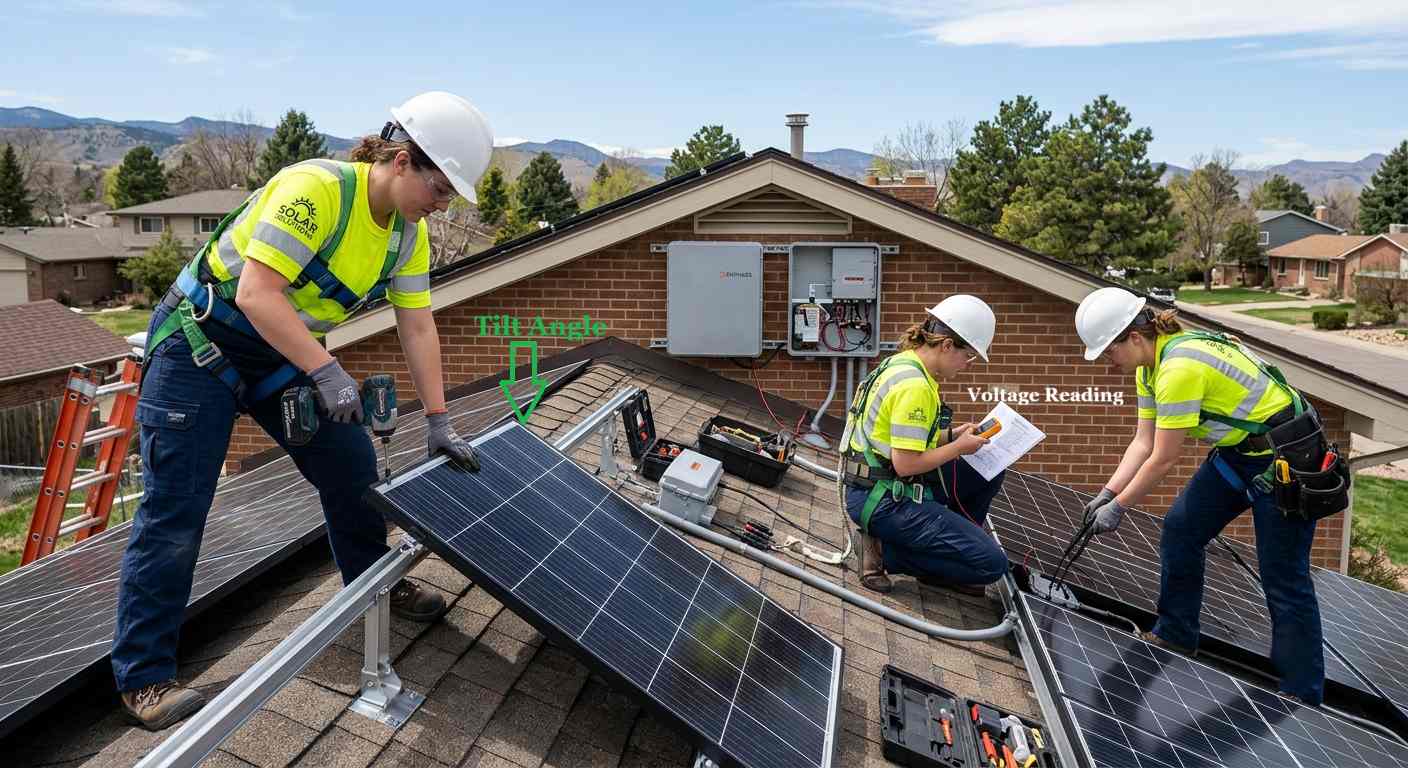
The installation of solar systems follows a specific sequence step by step, from the initial visit to the installation until the system is put into operation. Omitting any step of the process can lead to defects, complications, non-compliance with regulations, a reduced exposure to sunlight or risks to safety.

01
Site Assessment & Survey
Evaluate roof condition, structural integrity, orientation, shading analysis (using tools like SolarEdge or Shade Analysis), and local utility requirements. Measure roof pitch and available surface area.
Shade AnalysisRoof InspectionEnergy Audit
02
System Design & Engineering
Design panel layout, string sizing, inverter selection, and single-line electrical diagrams. Calculate estimated production using PVWatts or SAM (System Advisor Model). Choose panel brand and mounting hardware.
PVWattsString DesignLoad Analysis
03
Permits & Approvals
Submit building and electrical permits to the local authority having jurisdiction (AHJ). File interconnection application with the utility. HOA approval may be required. Timeline: 2โ€“8 weeks depending on jurisdiction.
Building PermitElectrical PermitNet Metering
04
Equipment Procurement
Order solar panels, mounting racking, inverters, disconnects, conduit, wire, breakers, monitoring equipment, and any battery storage. Verify equipment matches permit drawings before delivery.
PanelsRackingInverterBOS
05
Roof Penetrations & Mounting
Install flashing and lag bolts into rafters (staggered every other rafter for load distribution). Mount rails perpendicular or parallel to ridge. Apply sealant to all penetration points to prevent leaks.
FlashingsLag BoltsRails
06
Panel Installation
Mount panels to racking with mid- and end-clamps per manufacturer spec. Orient panels for optimal irradiance. Run inter-panel wiring in conduit or use MC4 connectors. Ground all metallic components.
MC4 ConnectorsGroundingTorque Spec
07
Electrical Wiring
Run DC wiring from panels to combiner box and to inverter. Install AC disconnect and run wiring to breaker panel. Install utility-side disconnect, revenue meter socket, and communication wiring for monitoring.
DC/AC WiringCombiner BoxMonitoring
08
Inspection & Utility Interconnect
Pass AHJ electrical and building inspections. Submit as-built drawings to utility. Utility installs bidirectional meter and authorizes Permission to Operate (PTO). Activate monitoring platform.
InspectionPTONet Meter
09
Commissioning & Monitoring
Energize system, verify production vs design estimates, register monitoring portal, and walk customer through system operation. Confirm inverter settings, rapid shutdown compliance, and string-level monitoring is operational.
EnergizeMonitoringHandover
โฑ Typical Timeline
Site Survey Day 1
Design + Permits 2โ€“8 Weeks
Physical Install 1โ€“3 Days
Inspection 1โ€“2 Weeks
Utility Interconnect 2โ€“6 Weeks
Total: 6โ€“16 Weeks
Average residential project from contract signing to first kilowatt-hour generated.
Panel Technology

Types of Solar Panels

Every solar panel technology available in the market has a different efficiency level. Factors to consider include appearance, price, performance in low light, and durability. Choose the right panel based on your budget, available space, and local Climate.

MONOCRYSTALLINE
Monocrystalline
Efficiency
17โ€“22%
Cost
$$$
Lifespan
25โ€“30 yr
Low Light
Excellent
Appearance
Uniform Black
Best For
Limited space, premium systems
POLYCRYSTALLINE
Polycrystalline
Efficiency
13โ€“17%
Cost
$$
Lifespan
20โ€“25 yr
Low Light
Good
Appearance
Blue Speckled
Best For
Budget installs, large spaces
THIN FILM (CdTe/CIGS)
Thin Film
Efficiency
10โ€“13%
Cost
$
Lifespan
15โ€“20 yr
Low Light
Very Good
Appearance
Dark Uniform
Best For
Large commercial, flat roofs
BIFACIAL (DUAL SIDE)
Bifacial
Efficiency
19โ€“23%
Cost
$$$$
Lifespan
25โ€“30 yr
Low Light
Excellent
Appearance
Glass-Glass
Best For
Ground mounts, high-albedo areas
Installation Parameters & Consideration

Angle, Height & Location

Optimal panel placement is the single biggest factor in maximizing energy output. Small errors in tilt or orientation can reduce generation by 10โ€“20%.

โ˜€ Optimal Tilt Angle by Latitude
Summer Sun Winter 30ยฐ Optimal Tilt: Lat ยฑ 15ยฐ 0ยฐN: 10โ€“15ยฐ 30ยฐN: 25โ€“35ยฐ 45ยฐN: 35โ€“50ยฐ 60ยฐN: 50โ€“60ยฐ Min 3m GROUND LEVEL Azimuth: True South (N. Hemisphere) / True North (S. Hemisphere)
๐Ÿ“ Tilt Angle Guide
Equatorial (0โ€“15ยฐN)10โ€“15ยฐ
Subtropical (15โ€“30ยฐN)20โ€“30ยฐ
Temperate (30โ€“45ยฐN)30โ€“40ยฐ
Northern (45โ€“60ยฐN)40โ€“55ยฐ
Fixed Flat Roof10โ€“15ยฐ min
Seasonal Adjustmentยฑ15ยฐ from base
๐Ÿ“ Orientation (Azimuth)
Northern HemisphereTrue South (180ยฐ)
Southern HemisphereTrue North (0ยฐ)
SE or SW deviationโ‰ค 45ยฐ acceptable
East-facingMorning priority
West-facingAfternoon/TOU peak
๐Ÿ“ Height & Clearance Requirements
Min roof clearance3 inches / 7.6 cm
Panel top from ridgeMin 6 inches
Ground mount height2โ€“4 ft from grade
Clearance from edge18โ€“36 inches (fire code)
Row-to-row spacingPanel height ร— cot(ฮฑ)
Min walkway clearance3 ft for service access
๐Ÿ—บ Ideal Location Factors
Annual irradiance> 4.5 kWh/mยฒ/day
Shading tolerance< 5% shading loss
Roof age remainingโ‰ฅ 10 years
Structural load3โ€“4 lbs/ftยฒ added
Snow/Wind zoneCheck IEC 61215
Salt/Coastal areasMarine-grade hardware
Interactive Tool

Solar System Calculator

Enter your details below to estimate the required area, panel count, system size, and expected annual energy generation for your solar installation.

โšก Solar Power Calculator
Global Leaders

Top 5 Solar-Producing Countries

These five nations lead the world in installed solar photovoltaic capacity, collectively generating over 75% of global solar electricity.

Installed Solar Capacity (GW) โ€” 2024
Source: IRENA / IEA 2024 estimates (GW = Gigawatts)
Share of Global Solar Capacity
GLOBAL 2,200 GW China (43%) USA (12%) India (9%) Japan (7%) Germany (6%)
๐Ÿ‡จ๐Ÿ‡ณ
China
Rank #1
World’s largest solar market with over 430 GW installed capacity. Dominates global panel manufacturing (85% of world production). Target of 1,200 GW by 2030. Massive desert solar farms in Gobi and Inner Mongolia.
๐Ÿ‡บ๐Ÿ‡ธ
United States
Rank #2
Over 170 GW capacity. Utility-scale projects in California, Texas, Nevada. IRA 2022 fueling exponential growth. California leads in residential, Texas in utility. Goal: 30% solar by 2030.
๐Ÿ‡ฎ๐Ÿ‡ณ
India
Rank #3
Fastest-growing market at 90 GW. Rajasthan’s Bhadla Solar Park is world’s largest single site (2,245 MW). National Solar Mission targets 280 GW by 2030. PM-KUSUM for agricultural solar.
๐Ÿ‡ฏ๐Ÿ‡ต
Japan
Rank #4
Over 85 GW installed. Post-Fukushima push for renewables drove rapid growth. Land-constrained so floating solar (Kagoshima) and agrivoltaics are pioneered here. High FIT subsidies historically.
๐Ÿ‡ฉ๐Ÿ‡ช
Germany
Rank #5
Europe’s largest solar market with 75 GW. Despite low sunshine, strong Energiewende policy drives adoption. High energy prices make solar economics compelling. 100% renewable target by 2035.
๐ŸŒ
Emerging Markets
Vietnam, Brazil, Australia, South Korea, Netherlands, Spain, and UAE are rapidly scaling up. Middle East MENA region emerging as solar powerhouse with ideal irradiance and large land availability.
System Health

Maintenance & Regular Checks

A well-maintained solar system operates at over 95% of its rated capacity for more than 25 years. Most maintenance involves simple visual inspections and cleaning off dust, as well as ensuring the system is securely supported so it does not shift or tilt during severe weather or high winds. Additionally, monitor the system’s performanceโ€”including Direct Current (DC) generationโ€”on a monthly basis and keep the records updated on a log sheet.

Weekly
โšก Quick Monitoring Check
  • โœ“Check inverter display/app for error codes or fault lights
  • โœ“Verify daily kWh generation matches expected output
  • โœ“Confirm monitoring system is online and reporting
  • โœ“Check battery state of charge (if applicable)
Monthly
๐Ÿ” Visual Inspection
  • โœ“Inspect panels for bird droppings, leaf debris, or dust accumulation from ground level
  • โœ“Check inverter LED status indicators and check fan operation
  • โœ“Review production data vs previous month / weather-corrected baseline
  • โœ“Inspect visible wiring at roof penetration for UV degradation
  • โœ“Check utility bill to confirm net metering credits are appearing
Bi-Annual
๐Ÿงน Panel Cleaning
  • โœ“Clean panels with deionized or soft water and a soft brush/squeegee โ€” early morning is best
  • โœ“Never use abrasive cleaners, harsh chemicals, or pressure washers on panel glass
  • โœ“Check mounting hardware for corrosion, loose bolts, or cracked flashings
  • โœ“Inspect roof surface around mounting points for signs of moisture intrusion
  • โœ“Clear any vegetation that has grown and is now casting shade on panels
Annual
๐Ÿ”ง Professional Service
  • โœ“Thermal imaging (IR scan) to detect hot spots, cell failures, or loose connections
  • โœ“IV curve tracing to measure string and panel-level performance degradation
  • โœ“Torque check all mounting hardware and electrical connections to spec
  • โœ“Inspect and test AC/DC disconnect switches, breakers, and surge protection
  • โœ“Battery capacity test and electrolyte check (for flooded lead-acid systems)
  • โœ“Update inverter firmware and monitoring system software
5โ€“10 Year
๐Ÿ”„ Long-Term Component Service
  • โœ“String inverter replacement typically at year 10โ€“15 (fan/capacitor wear)
  • โœ“Microinverter warranty claim if individual unit fails (25-yr warranty standard)
  • โœ“Battery bank replacement at 7โ€“12 years (lithium) or 5โ€“7 years (lead-acid)
  • โœ“Re-seal all roof penetrations and re-caulk flashings
  • โœ“Replace plastic conduit fittings showing UV cracking
  • โœ“Reassess optimal tilt if tree growth has increased shading
๐Ÿ“‰ Panel Performance Degradation Over Time
100% 95% 90% 85% Year 0 5 10 15 20 25yr Mono ~83% Poly ~79% โ€” Manufacturer 80% Warranty Line 100% Mono: ~0.5%/yr degradation | Poly: ~0.6โ€“0.7%/yr
Problem Solving

Troubleshooting Tips

Most solar system issues can be detected through monitoring data before any physical inspection is required. Use this guide to identify and resolve common problems as per log sheet performance.

โšก
Low or Zero Energy Production
โ–พ

Zero output is the most urgent issue. Start with the simplest causes first before escalating to electrical diagnostics.

  • Check inverter โ€” is it powered on? Look for error code on display or app
  • Verify AC main breaker and DC array breaker are both in ON position
  • Check for grid outage โ€” grid-tied inverters shut down automatically during outages (anti-islanding)
  • Inspect rapid shutdown device (RSD) โ€” ensure it is activated and not tripped
  • Check for extreme shading from seasonal tree growth, snow cover, or bird nests
  • Verify monitoring shows same day-of-week/season as last year for weather-adjusted comparison
  • If microinverters: use string-level monitoring to identify failed individual units
๐Ÿ“‰
Gradual Production Decline (10โ€“25% loss)
โ–พ

Gradual decline over weeks or months usually points to soiling, shading, or a failing component in one string.

  • Schedule professional panel cleaning โ€” dust accumulation causes 5โ€“25% production loss
  • Review string-level monitoring: is one string consistently underperforming vs others?
  • Check for new shading sources: grown trees, new neighbor construction, satellite dishes
  • Inspect for cracked panels or delamination (visible bubbling or yellowing of encapsulant)
  • Test MC4 connections with thermal camera to identify resistive hot spots
  • Verify inverter clipping: system may be undersized for panel array (MPPT range exceeded)
  • Check bypass diodes โ€” failed diode eliminates one-third of a panel’s cells
๐ŸŒก
Inverter Overheating / Thermal Shutdown
โ–พ

Inverters are rated for operation up to 40โ€“55ยฐC ambient temperature. Hot climates or poor ventilation cause thermal throttling.

  • Relocate inverter away from direct sunlight โ€” north-facing wall or shaded area is ideal
  • Ensure minimum 6-inch clearance on all sides for air circulation
  • Clean inverter cooling fins/fan intake โ€” dust buildup greatly reduces cooling
  • Replace inverter cooling fan if seized or running intermittently
  • Check that ventilation louvers in inverter enclosure are not blocked by insulation or debris
  • Consider adding a shade panel above outdoor-mounted inverters
๐Ÿ”‹
Battery Not Charging / Discharging Correctly
โ–พ

Battery system issues are often configuration or BMS-related. Physical battery failure is less common in the first 5 years.

  • Check BMS error codes: cell imbalance, over-temperature, or low state of health (SoH)
  • Verify charge and discharge setpoints in inverter configuration match battery spec
  • Test battery with calibration cycle: full charge โ†’ full discharge โ†’ full charge to reset SoC reading
  • Check communication cable between inverter and battery (CAN bus or RS485 disconnection is common)
  • Verify battery is within operating temperature range (most Li batteries: 0โ€“45ยฐC)
  • For lead-acid: measure specific gravity of each cell โ€” replace cells with reading below 1.15
๐Ÿ’ง
Water Intrusion at Roof Penetrations
โ–พ

Roof leaks from solar installations are rare but serious. Always use flashing, not just sealant alone, for roof penetrations.

  • Identify leak source by running a hose test (one zone at a time) rather than assuming the penetration is the cause
  • Replace split or cracked butyl tape on flashings โ€” do not just apply more sealant over old failed sealant
  • Check that flashing slides under the uphill shingle (correct waterfall-style install)
  • Ensure no standing water can pool on flat or low-pitch sections around mounts
  • If asphalt shingles are granular-depleted around penetrations, consider shingle replacement before re-sealing
  • Document all penetration locations for roofer reference and warranty purposes
๐Ÿ“ก
Monitoring System Offline / No Data
โ–พ

Monitoring outage does not necessarily mean the system stopped producing โ€” it may just be a communication issue.

  • Check home WiFi router โ€” monitoring gateways lose connection after router password change
  • Re-pair monitoring gateway to WiFi network using manufacturer app/instructions
  • Power-cycle the monitoring gateway (unplug for 60 seconds)
  • Verify inverter is still producing by checking LED status and display reading
  • Update monitoring app โ€” outdated app versions sometimes lose server compatibility
  • Check if cloud monitoring server is down (most manufacturers have status pages)
  • For cellular monitoring: check cellular data plan renewal and signal strength at install location
Known Issues

Common Challenges

Understanding the challenges of solar installation helps set realistic expectations and allows for proactive mitigation strategies during the design phase.

๐ŸŒฅ Intermittency & Weather
Solar panels produce no power at night and reduced power on cloudy days. A system sized for average irradiance will underperform during extended low-light periods. Mitigation: battery storage, grid backup, or generator integration. Use 10-year weather averages, not single-year data, for system sizing.
๐Ÿ  Roof Compatibility Issues
Asphalt shingle roofs nearing end-of-life (20+ years) should be replaced before solar installation โ€” removing panels mid-life for roofing costs 2โ€“3ร— more. Tile, slate, and metal roofs require specialty mounting hardware. Flat roofs require ballasted or penetrating systems with specific wind uplift calculations.
๐ŸŒณ Shading & Soiling
In a standard string system, one shaded panel drags down the entire string โ€” “Christmas light effect.” Shade from chimneys, vents, trees, or neighboring buildings can eliminate 25โ€“50% of potential generation. Solutions: microinverters, DC optimizers (SolarEdge/Tigo), or careful layout design to avoid shaded cells in strings.
๐Ÿ“‹ Permit & Grid Delays
Interconnection applications can take 2โ€“8+ months in congested grid areas. Some utilities impose capacity limits on residential generation. Export limits, export tariffs, or retroactive policy changes can affect financial projections. Always secure utility agreement before signing installation contracts.
๐Ÿ’ธ Upfront Cost & Financing
Average residential system (6โ€“10 kW) costs $15,000โ€“$30,000 before incentives. Despite 30% federal ITC (USA), initial capital is a significant barrier. Solar loans (often 6โ€“8% APR) erode savings. Lease/PPA structures lock homeowners in and complicate property sales. Always model multiple financing scenarios.
๐ŸŒก Temperature Performance Loss
Silicon cells lose ~0.3โ€“0.5% efficiency per ยฐC above 25ยฐC (STC). A panel operating at 65ยฐC on a hot roof loses 15โ€“20% of rated power. Proper air gap under panels, panel color choice, and selecting panels with low temperature coefficient (-0.30%/ยฐC is excellent) mitigate this. Desert climates with high heat have counter-intuitive production losses.
System Architecture

Block Diagram โ€” Complete Solar System

A comprehensive solar energy system consists of multiple interconnected subsystems. This block diagram illustrates the complete signal and power flow from sunlight capture to end-use consumption.

SOLAR PHOTOVOLTAIC SYSTEM โ€” COMPLETE BLOCK DIAGRAM SOLAR ARRAY Monocrystalline / Poly DC Output: Voc, Isc DC POWER DC COMBINER BOX Fuses + Surge Prot. String aggregation DC DC DISC- ONNECT Safety Shutoff INVERTER DC โ†’ AC Conversion MPPT Controller Anti-Islanding Protection Grid Synchronization 240V AC / 50-60Hz AC AC DISC- ONNECT Service Entrance MAIN PANEL Service Entrance / Breakers Load Distribution Net Metering Connection Bidirectional Meter HOME LOADS Lights, HVAC, EV Appliances, Water Heater UTILITY GRID Export/Import CHARGE CTRL BMS / MPPT Charge Cell balancing, protection Optional (Hybrid/Off-grid) BATTERY BANK LiFePO4 / Li-NMC / Lead-Acid 5โ€“30 kWh Capacity 48V DC (typical) ENERGY STORAGE MONITORING Data logger / Gateway WiFi / Ethernet / Cellular Cloud dashboard + alerts SCADA / App / Web Portal RS485 / CAN / WiFi RAPID SHUTDOWN NEC 2017+ Requirement Emergency firefighter safety LEGEND: DC Power Flow AC Power Flow Grid Exchange Communication/Data Optional Path NOTE: Battery / Charge Controller path is optional (On-Grid systems omit battery entirely). Rapid Shutdown required by NEC 690.12 for rooftop systems.
โ˜€๏ธ
Solar Array
Converts sunlight to DC electricity. Core power source.
๐Ÿ”„
Inverter
Heart of the system. DCโ†’AC conversion with MPPT.
๐Ÿ”‹
Battery Storage
Stores excess generation for later use. Optional.
๐Ÿ“Š
Monitoring
Real-time data, alerts, and performance analytics.
โ˜€ SOLAR INSTALLATION EXECUTION
For educational Skill and planning purposes. Before Starting as Startup then, always consult a licensed solar installer and local electrical authority before installation.
IEC 61215 Compliant NEC 2020 Reference IRENA Data 2024

Leave a Comment

Your email address will not be published. Required fields are marked *