
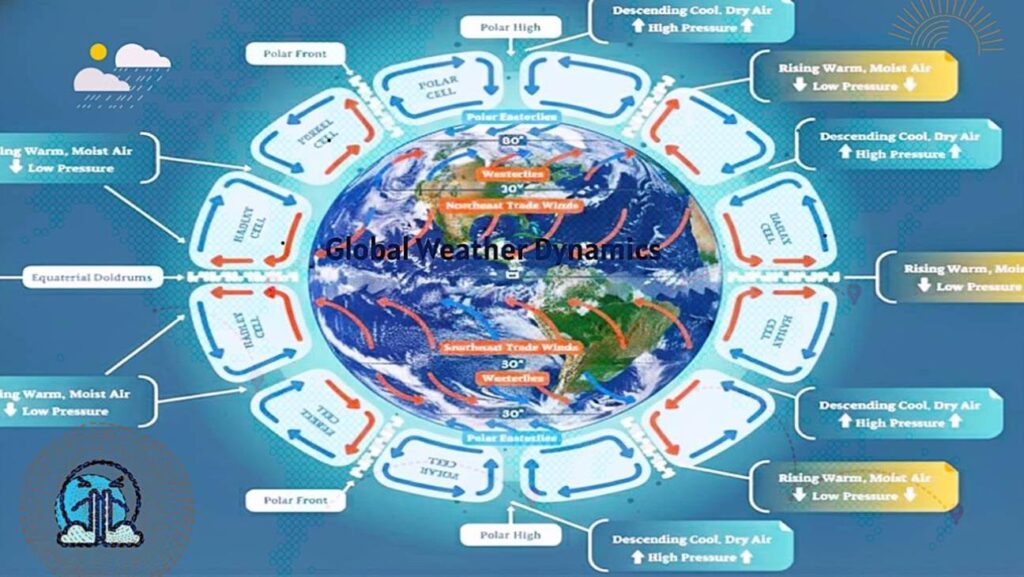
Global System of Meteorological
Understanding the forces that drive our climate: from local weather to global fluctuations
Chapter 1: The World Monsoon Cycle (Visualizer)
The land heats up much faster than the ocean, creating intense Low Pressure (HOT). Air flows from the high-pressure ocean to the land (SURFACE FLOW), rises over the hot land (RISING AIR), cools, and forms RAIN. This is a powerful Convective Cycle.
Chapter 2: Types of Monsoons and Regional Variation
| Type / Region | Wet Period (Approx.) | Temp (Wet) | Dominant Wind Flow | Country | Climate | Key Regional Name / Factor |
|---|---|---|---|---|---|---|
| South Asian | June to September | High (25°C – 35°C) | Strong Southwest (Ocean → Land) | India / Bangladesh | Tropical Monsoon (Am) | Tibetan Plateau Heating / Somali Jet |
| East Asian | May to August | Moderate to High (20°C – 30°C) | Southeast (Ocean → Land) | China / Japan | Humid Subtropical (Cfa) | Meiyu (China) / Baiu (Japan) Front |
| West African | July to September | High (25°C – 40°C) | Southwest (Atlantic → Land) | Nigeria / Mali (Sahel) | Tropical Savanna (Aw) / Steppe (BSh) | African Easterly Jet (AEJ) |
| North American | July to September | High (25°C – 35°C) | Southeast (Pacific/Gulf → Land) | Mexico / USA (SW) | Desert (BWh) / Steppe (BSh) | Mexican Plateau / Gulf of California Moisture |
| Australian (Northern) | December to March | High (25°C – 35°C) | Northwest (Ocean → Land) | Australia (NT/QLD) | Tropical Savanna (Aw) | Indonesian Low Pressure / Madden-Julian Variation |
Chapter 3: The Coriolis Effect (The Deflecting Force)
Definition & Mechanics
The Coriolis effect is an apparent force that results from the Earth’s rotation. It does not cause the wind, but it deflects its direction, creating the swirling patterns seen in global wind systems and ocean currents.
- Northern Hemisphere: Wind (and water) is deflected to the RIGHT.
- Southern Hemisphere: Wind (and water) is deflected to the LEFT.
- Monsoon Impact: The Southwest Monsoon winds are a result of this effect turning southeast trades that cross the equator to the right.
Deflection Diagram Concept
N. Hemisphere: Deflection to RIGHT
Applies to hurricanes, low pressure systems, and wind direction.
S. Hemisphere: Deflection to LEFT
Applies to cyclones, high pressure systems, and wind direction.
Chapter 4: El Niño /The Girl (ENSO)
The Ocean’s Influence on Global Climate
The The Child Southern Variation(ENSO) describes the periodic shifts in sea surface temperatures (SST) in the central and eastern tropical Pacific Ocean. These shifts dramatically impact global weather, especially the monsoon cycle in Asia.
| Variable | El Niño Phase | La Niña Phase |
|---|---|---|
| Pacific SST | Warmer than average (Weakens upwelling) | Cooler than average (Strengthens upwelling) |
| Trade Winds | Weaker or reversed | Stronger than normal |
| Asian Monsoon Impact | Associated with weaker monsoon and drought risk. | Associated with stronger monsoon and flood risk. |
| Global Temperature | Tends to increase global average temperature. | Tends to decrease global average temperature slightly. |