
Signal Integrity in PCB Design
A comprehensive guide to understanding signal quality in modern electronics.
What is Signal Integrity?
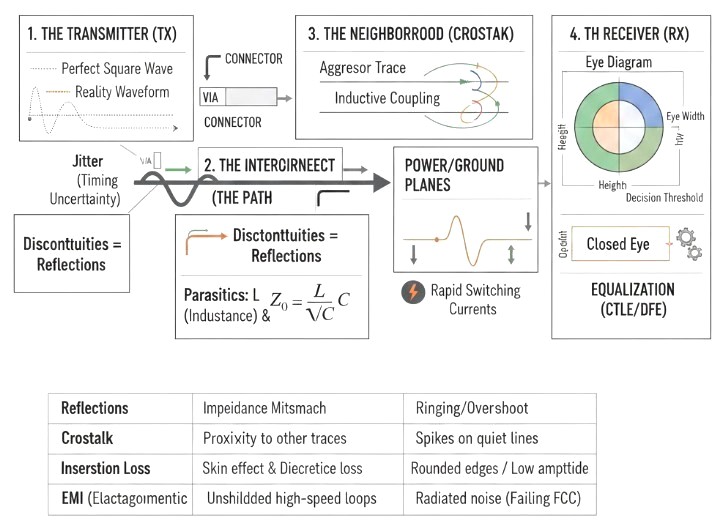
Signal integrity (SI) refers to the quality of electrical signals as they travel through conductors on a printed circuit board (PCB). Fundamentally, it is about ensuring that signals arrive at their destination with the correct voltage levels, timing, and waveform shape, without distortion or interference that could cause errors in digital circuits or degradation in analog performance.
“In simple terms, signal integrity is the practice of making sure electronic signals remain ‘clean’ and recognizable as they move from one component to another on the board.”
Key Signal Integrity Issues
1 Reflections
When a signal encounters an impedance mismatch along its path, part of the signal energy reflects back toward the source. This creates voltage spikes (overshoot/undershoot) and ringing (oscillations) that can cause false triggering or data errors.
Concept: Reflection Coefficient (Gamma)
The amount of reflection is determined by the mismatch between the transmission line characteristic impedance (Z0) and the load impedance (ZL).
Example
Imagine a 3.3V signal traveling down a 50Ω trace that hits an open connection (infinite impedance). The reflection coefficient is +1, meaning 100% of the energy reflects back. This adds to the incoming wave, momentarily doubling the voltage to 6.6V at the pin, potentially damaging the component.
2 Crosstalk
Crosstalk happens when a signal on one trace induces unwanted voltage on an adjacent trace through electromagnetic coupling (inductive and capacitive).
Concept: Aggressor & Victim
The trace switching state is the “Aggressor,” and the adjacent quiet trace is the “Victim.” We measure this as Near-End Crosstalk (NEXT) and Far-End Crosstalk (FEXT).
Example
Consider two parallel traces running for 5 inches on a PCB with very tight spacing (e.g., 4 mils). When the Aggressor switches rapidly from 0V to 3.3V, it capacitively couples a voltage spike onto the Victim trace. If the Victim line was supposed to be a steady 0V, this spike might be read as a logic “1” by the receiver.
3 Ground Bounce & Power Noise
When multiple outputs switch simultaneously, they can cause transient voltage fluctuations on the power and ground planes.
Concept: SSN & Inductance
Simultaneous Switching Noise (SSN). Voltage is induced across a conductor’s inductance when current changes rapidly:
Example
A 32-bit data bus switches from all 0s to all 1s instantly. This demands a massive surge of current. The inductance in the IC package pins resists this change, causing the voltage on the chip’s internal ground rail to momentarily bounce above 0V. A “Low” output might briefly look like 1.5V, causing logic errors.
4 Electromagnetic Interference (EMI)
Poor signal integrity often leads to electromagnetic radiation that interferes with other devices or violates regulatory standards (like FCC or CE).
Concept: Return Path & Loop Area
High-frequency return current follows the path of least inductance, which is directly underneath the signal conductor. If this path is broken, the current forms a large loop.
Example
A high-speed clock signal is routed over a split in the ground plane. The return current cannot follow the trace; it must detour around the split. This creates a large loop area that acts like a loop antenna, radiating noise into the environment.
5 Timing Issues
Signal degradation can cause significant timing violations in high-speed digital systems.
Concept: Jitter & Skew
- Skew: The time difference between two signals that should happen simultaneously.
- Jitter: The deviation of a clock edge from its ideal position.
Example
In a DDR memory interface, if the trace for Data Bit 0 is 2 inches longer than the Strobe trace, the data arrives late (propagation delay). The memory controller might try to read the data before it has arrived and stabilized, resulting in a corrupted read/write.
6 Transmission Line Losses (Attenuation)
As signals travel through a PCB, they lose energy. This attenuation rounds off the edges of digital pulses and shrinks the signal amplitude.
Concept: Dielectric & Skin Effect
- Skin Effect: At high frequencies, current only flows on the outer “skin” of the copper, increasing resistance.
- Dielectric Loss: The PCB material itself absorbs energy, converting it to heat.
Example
A 10 Gbps signal traveling across a 20-inch backplane will look sharp at the source but may arrive at the receiver as a small, rounded wave that is barely distinguishable from background noise due to high-frequency attenuation.
Diagnosing Signal Integrity
The Eye Diagram
The Eye Diagram is the gold standard for measuring SI. It is created by overlapping multiple bits of a data stream on top of each other on an oscilloscope.
What to look for:
- • Eye Opening: Larger opening = better signal quality.
- • Jitter (Width): Blurriness on the horizontal edges.
- • Noise (Height): Thickness of the horizontal lines.
Eye Mask (Keep Clear)
How Signal Integrity Affects PCB Design
Trace Routing
Traces are no longer just connections; they are transmission lines.
- Impedance Control: Manage trace width and spacing (50Ω/100Ω).
- Termination: Use Series (source) or Parallel (load) resistors to match impedance.
Layer Stackup
The arrangement of copper and dielectric layers directly impacts performance.
- Reference Planes: Adjacent solid ground planes minimize loop area.
- Materials: Use Rogers or Isola for GHz speeds instead of lossy FR-4.
Differential Signaling
Used for USB, HDMI, PCIe to reduce common-mode noise.
- Tight Coupling: Pairs must be routed close together.
- Length Matching: Essential to maintain noise-canceling benefits.
Advanced SI Considerations
Decoupling Capacitors
These act as local energy reservoirs to combat Ground Bounce. They provide the high-frequency current needed when an IC switches, preventing the voltage from dipping.
Via Parasitics
Vias introduce capacitance and inductance. At very high speeds (above 5GHz), a via can act like a discontinuity, causing massive reflections unless it is “back-drilled” to remove unused copper stubs.