
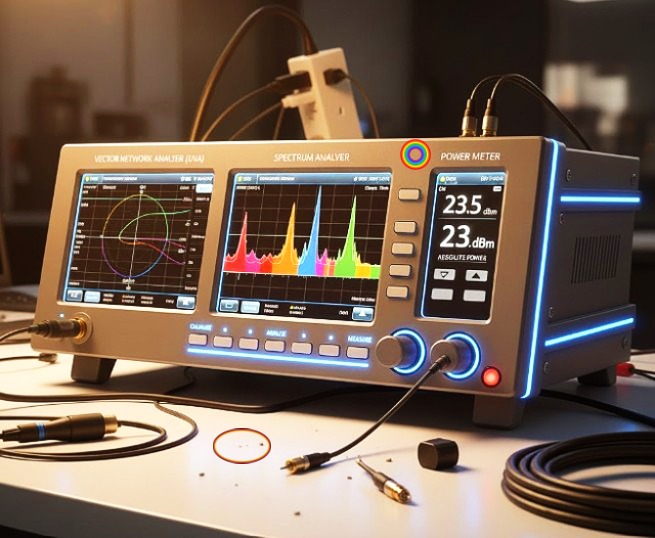
VNA-Spectrum-Analyzer-Power
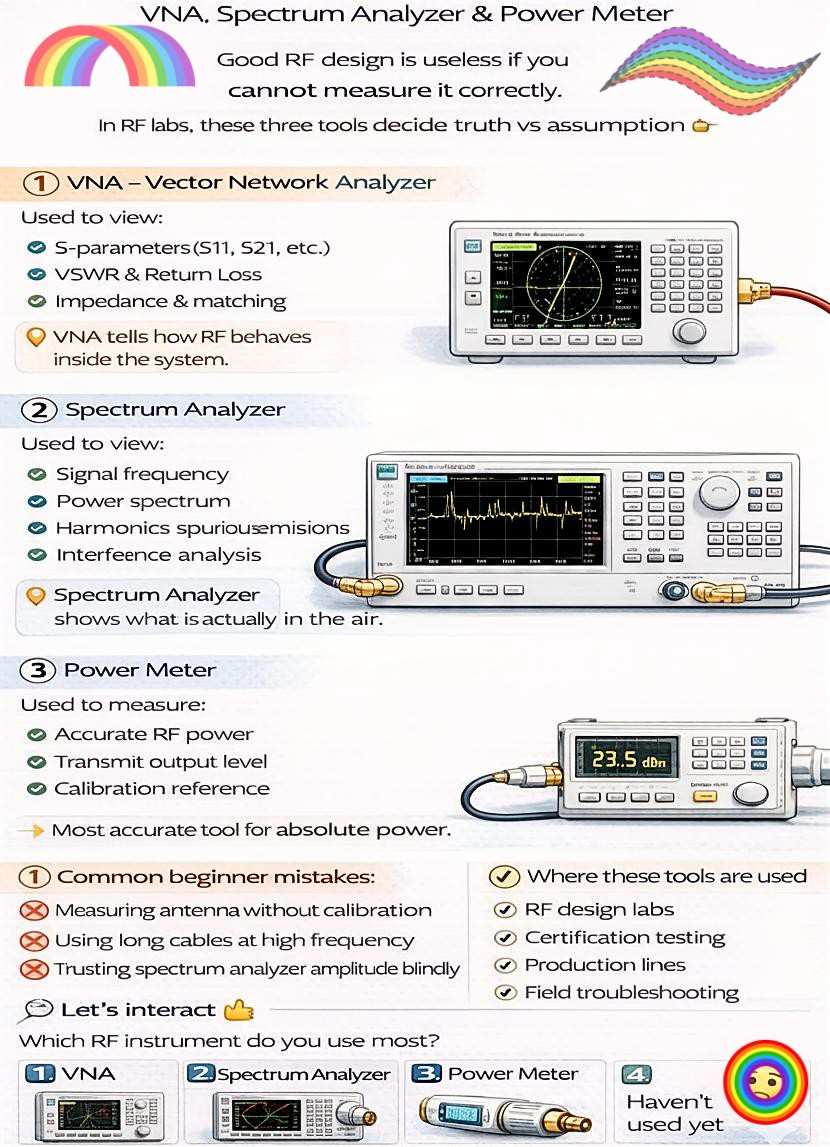
VNA-Spectrum-Analyzer-Power
1. VNA – Vector Network Analyzer
📌 Bottom Line: Tells how RF behaves INSIDE the system (Stimulus/Response).
Used to measure:
- S-parameters: (S11, S21, etc.) reflection/gain.
- VSWR & Return Loss: Reflected power checks.
- Impedance: Smith Chart matching.
- Group Delay: Phase linearity over frequency.
- Port Isolation: Cross-talk between ports.
Only tool that measures Phase, essential for complex impedance & group delay.
💡 Real-World Example
Designing a Wi-Fi antenna with -3dB Return Loss (50% signal lost). Use the VNA to add matching components until S11 hits -20dB (99% power delivered).
💎 Deep Dive: TDR & Port Extensions
TDR (Time Domain Reflectometry): Visualize where a cable is broken or a trace mismatch occurs in physical distance (cm/inches).
Port Extension: Use this feature when you must add an adapter AFTER calibration to mathematically “move” the reference plane to the new connector tip.
Time Domain Gating: Allows you to isolate a specific reflection (like a connector) and “gate” it out to see the true performance of your Device Under Test (DUT).
2. Spectrum Analyzer (SA)
📌 Bottom Line: Shows what is actually IN THE AIR (Frequency Domain).
Used to view:
- Signal Frequency: Center & drift.
- Power Spectrum: Energy distribution.
- Harmonics & Spurs: Unwanted “trash”.
- Interference: Hidden signal hunting.
- Phase Noise: Spectral purity of oscillators.
Resolution Bandwidth (RBW) is your magnifying glass—lower RBW equals more detail but slower sweeps. Improve efficiency with segmented sweeps by applying different point densities or IF bandwidth (IFBW) across different frequency ranges. Use time-domain gating to isolate the DUT signal by removing unwanted reflections. Port extension mathematically shifts the calibration plane to the fixture. Group delay measures the rate of phase change to ensure signal integrity. Compression (P_1dB) characterizes the linearity of active devices.
💡 Real-World Example
Troubleshooting Bluetooth dropouts? See a massive spike at 2.44GHz on the SA? You found a leaky microwave causing interference.
💎 Deep Dive: Zero Span & VSA
Zero Span: Acts like an oscilloscope in the frequency domain. Critical for pulsed Radar/LTE packet timing.
VSA (Vector Signal Analysis): Modern SAs can demodulate digital signals (64QAM, OFDM) to show Error Vector Magnitude (EVM) and Constellation diagrams.
OBW (Occupied Bandwidth): Measures the frequency band containing 99% of the total integrated power. Vital for regulatory compliance (FCC/ETSI).
3. Power Meter
📌 Bottom Line: Most accurate tool for ABSOLUTE POWER.
Used to measure:
- Accurate RF Power: Watts or dBm.
- Transmit Level: Final spec verification.
- Calibration Ref: Validating SAs & VNAs.
Uses specialized thermal or diode sensors for NIST-traceable precision.RF power meters accurately measure absolute power (dBm/watts), which is essential for validating transmitter specifications and calibrating spectrum and network analyzers. Calibration ensures traceability and corrects for mismatch uncertainty. Choose a thermal or diode sensor based on the signal modulation and bandwidth.
💡 Real-World Example
Base station says 43dBm (20W). SA shows 41.5dBm. Use a Thermal Sensor to get the TRUE 43.01dBm reading for FCC compliance.
💎 Deep Dive: Pulse Power & Duty Cycle
For pulsed signals, the Average Power = Peak Power × Duty Cycle. If your sensor only measures average, you must calculate peak manually.
Sensor Linearity: Diode sensors are faster but non-linear at high power levels. Thermal sensors integrate power regardless of modulation type (CW vs. Complex Digital).
4. Mixed Domain & Signal Gen
📌 Bottom Line: Synthesis and Time-Domain Correlation.
Signal Generator (SigGen)
The “Pure Source.” Use it to inject a known signal into an amplifier to test gain, compression (P1dB), and intermodulation (IP3). Modern ones support I/Q modulation.
Mixed Domain Oscilloscope
Allows looking at a time-domain signal (SPI/I2C bus) and its RF spectrum simultaneously. Perfect for EMI troubleshooting.
VSWR vs Return Loss Quick Ref
🚀 Advanced -Tips
A scalar network analyzer (SNA) measures amplitude only, while a vector network analyzer (VNA) measures both magnitude and phase (vector). Dynamic range and trace averaging (vs. peak) are also key considerations.
The Noise Floor Secret
Set Attenuation to 0dB and Pre-Amp to ON to see extremely weak signals (lowers DANL). Use a low RBW for further noise reduction.
VNA Calibration Planes
Always calibrate at the end of the cable, not the port. This removes the phase shift and loss of the test cable from the result.
Dynamic Range Fact
VNAs offer ~120dB+ dynamic range, while SAs offer ~80-90dB. Use VNAs for deep filter rejection floors.
Connector Torque
Hand-tightening causes repeatability errors. Use a calibrated 8 in-lb torque wrench for SMA connectors.
Phase Stability
Do not bend high-quality RF cables during a VNA measurement. Bending changes dielectric properties, causing “phase swing.”
Average vs. Peak Trace
Use “Max Hold” on an SA to capture bursty signals like Wi-Fi. Use “Average” trace to measure stable CW signals or noise.
⚠️ Common Beginner Mistakes
No Calibration: Measuring through un-calibrated cables includes the cable in your result.
Long Cables: At high frequencies (10GHz+), cheap long cables will “eat” your entire signal through dielectric loss.
Blind Trust: SAs have +/- 2dB uncertainty. Never trust amplitude for absolute power verification.
Missing DC Block: Connecting live DC lines (like an LNA bias-T) to sensitive mixers will fry the instrument.
SMA/3.5mm Mix: Cheap SMA pins can be too long and permanently crush precision 3.5mm sockets.
Over-torque: Using regular wrenches strips threads and deforms center pins, causing high VSWR.
Input Overload: Saturated internal mixers create “ghost” harmonics. Increase input attenuation.
Poor Grounding: Long ground “pigtails” act like inductors at GHz frequencies, ruining return paths.
Lab Work and Maintenance
1. ESD Protection
RF Mixers are microscopic. A static spark you can’t even feel can destroy a microwave front-end. Always wear an ESD wrist strap.
2. Connector Care
Inspect connectors with a magnifying glass. A single bent pin can destroy every port it touches. Use alcohol and lint-free swabs.
3. OCXO Warm-Up
Precision instruments require 30-60 minutes to reach thermal stability before a final calibration.
4. RF Radiation Safety
High-power amplifiers (>1W) can cause tissue heating. Never look directly into an open waveguide during transmission.
5. Maximum Input Levels
Most instruments are rated for +20dBm max. Always use an external attenuator if measuring high-gain amplifiers.
Golden Rule of RF
“Check the connector, then check the torque, then check the cal.”
Summary & Comparison
| Feature | VNA | Spec Analyzer | Power Meter |
|---|---|---|---|
| Logic | Stimulus-Response | Passive Listener | Passive Sensor |
| Domain | Freq & Phase | Frequency (mag) | Power Only |
| Accuracy | High (Relative) | Moderate (+/- 1dB) | Extreme (+/- 0.1dB) |
| Strength | Impedance Matching | Signal/Spur Hunting | True Power Truth |