
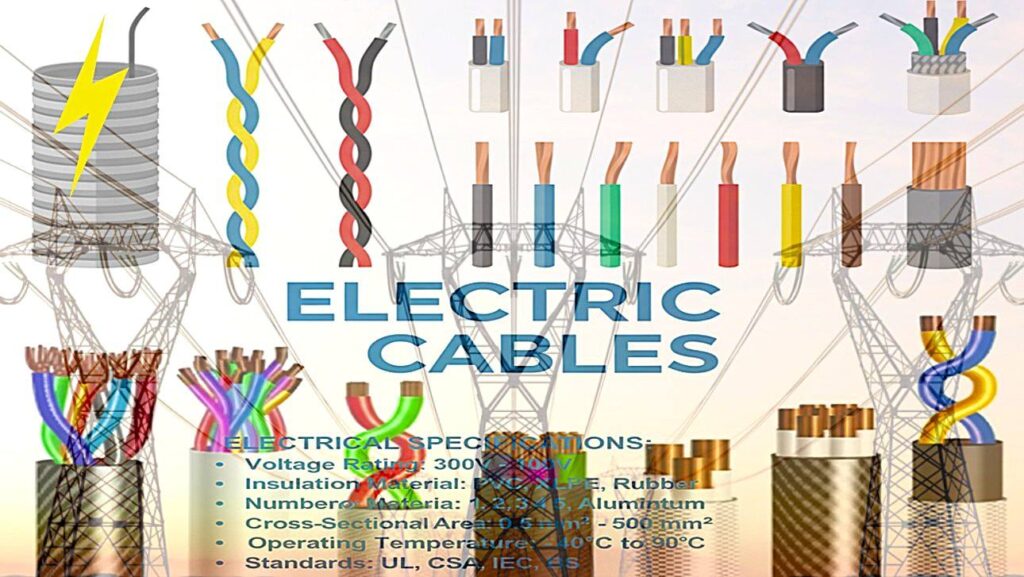
Interactive Electrical Power Cables and Specification
An interactive Tecxskill to explore cable types, understand their specifications of Electrical components, and see how specifications impact performance in industrial parameter .
Cable Explorer
Filter cables by type or feature. Click on the icons Card to follow in details and typical current ranges.
Cable Anatomy: A 2D Technical View
This cross-section illustrates the key layers of a typical power cable, each with a specific function. Understanding these layers is fundamental to cable design and application.
Overall Cable Summary
Component Deep-Tech Spec
Explore core cable components: conductors, insulation, and ampacity factors.
Conductor Materials: Copper vs. Aluminum
Copper (Cu)
- Higher Conductivity: Carries more current for the same size.
- Greater Strength: More resistant to breaking during installation.
- Corrosion Resistance: Less prone to oxidation issues at terminals.
- Cost: Generally more expensive than aluminum.
Aluminum (Al)
- Lighter Weight: About one-third the weight of copper.
- Lower Cost: Significantly more economical, especially for large cables.
- Larger Size Needed: Requires a larger cross-section for the same ampacity.
- Oxidation: Forms an insulating oxide layer, requiring special termination techniques.
Insulation Materials
Insulation prevents current leakage. Its thermal rating limits a cable’s ampacity. The chart shows typical max operating temperatures.
Understanding Ampacity
Ampacity is the maximum current a cable can carry under specific conditions. Use the sliders to see how environmental factors “derate” its base rating.
Effective Ampacity
of Base Rating