
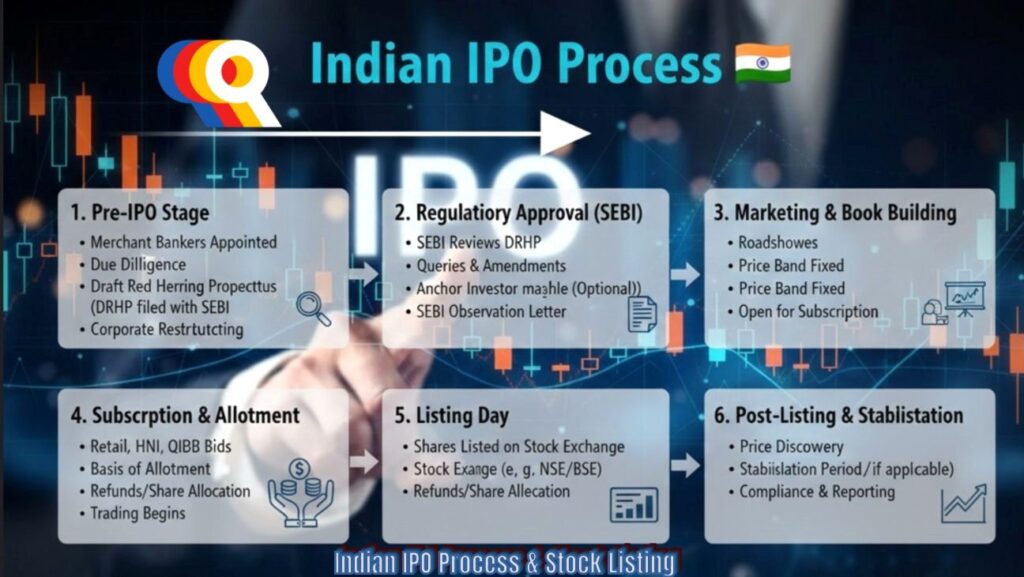
IPO Launch Roadmap in India (SEBI & Exchanges)
A structured, step-by-step guide for companies aspiring to list on the Mainboard (BSE/NSE) or the Innovators Growth Platform (IGP).
Phase I: Corporate Readiness & Financial Standards (The Mainboard Path)
Before starting the process, the company must meet stringent financial and regulatory criteria as per SEBI (Issue of Capital and Disclosure Requirements) Regulations, 2018. If a company fails to meet these, it may need to allocate 75% of the net offer to Qualified Institutional Buyers (QIBs).
| Criterion (Entry Norm I) | SEBI Requirement | Notes |
|---|---|---|
| Net Tangible Assets | Minimum ₹3 Crores in each of the preceding three full years. | Not more than 50% can be cash or bank balances (if fresh issue). |
| Net Worth | Minimum ₹1 Crore in each of the preceding three full years. | Calculated on a restated and consolidated basis. |
| Average Operating Profit | Average pre-tax operating profit of at least ₹15 Crores in at least three of the immediately preceding five years. | This ensures operational stability and consistent income. |
| Issue Size Limit | The issue size must not exceed 5 times the pre-issue net worth. | This prevents excessive dilution relative to company size. |
| Promoter/Director Compliance | None of the promoters, directors, or selling shareholders should be debarred from accessing the capital market by SEBI. | Strict check on past regulatory offenses or wilful defaults. |
Example: Net Worth Compliance
If a company’s Net Worth for the last three years was ₹80 Lakh, ₹95 Lakh, and ₹1.1 Crore, it fails Entry Norm I because the Net Worth must be a minimum of ₹1 Crore in *each* of the three years. It would likely need to use the QIB route (75% allocation).
Innovators Growth Platform (IGP) Eligibility for Startups
The IGP is designed for technology-intensive companies and offers relaxed profitability criteria, provided there is substantial pre-existing institutional participation.
- Technology Focus: The company must be intensive in the use of technology, IT, intellectual property, data analytics, or bio-technology.
- Investor Holding: At least 25% of the pre-issue capital must be held by QIBs, Family Offices (with AUM of ≥ ₹500 Crores), or SEBI-registered AIFs/VCFs with a minimum corpus of ≥ ₹25 Crores.
- No Profit Track Record Required: This is the key advantage; standard Mainboard profitability metrics do not apply.
- Mandatory Lock-in: All pre-issue capital must be locked in for 6 months (compared to 18 months for Mainboard promoters).
Note: Requirements vary slightly for SME IPOs (post-issue paid-up capital ≤ ₹25 Crores) and non-profitable companies (which must use the QIB route).
Phase II: Assembling the IPO Team & Due Diligence
Step 1: Appoint Merchant Bankers (BRLMs)
The most crucial appointment. They manage the entire issue, including regulatory filings, marketing, and underwriting. Fact: BRLMs are responsible for the valuation and must conduct independent due diligence.
Step 2: Appoint Legal & Audit Team
Engage Legal Counsel (for compliance), Independent Auditors (to restate financials), and Registrar to the Issue (for share applications). Fact: The Auditor must issue a Comfort Letter to the BRLMs regarding financial disclosures.
Step 3: Internal & External Due Diligence
A rigorous legal, financial, and business review is conducted by the BRLMs and lawyers. Fact: Due diligence must cover the preceding five years of company operations, scrutinizing all major contracts and titles.
Phase III: Documentation, Filings, and Approvals
Step 4: Draft Red Herring Prospectus (DRHP) Preparation
The DRHP is the primary document containing exhaustive details. It’s jointly finalized by the company and the BRLMs. Fact: The “Risk Factors” section must be the first major section and must detail at least 15-20 material risks.
Example: DRHP Risk Factor
A typical risk factor might state: “Our business operations are highly dependent on two major suppliers, and the disruption of our relationship with either supplier would adversely affect our ability to provide services.” This informs investors of key business vulnerabilities.
Step 5: Filing the DRHP with SEBI and Exchanges
The DRHP is officially filed with SEBI, the Registrar of Companies (RoC), and the designated Stock Exchanges (BSE/NSE). This formally starts the regulatory timeline.
Step 6: SEBI Observation Letter (The Approval)
SEBI reviews the DRHP for compliance (typically 2-4 months) and issues an Observation Letter detailing required amendments. Fact: SEBI’s observation is valid for 12 months from the date of issuance; the IPO must be launched within this period.
Example: SEBI Timeline
If SEBI issues its observation letter on January 15, 2026, the company must open its public bidding window (the IPO launch) no later than January 14, 2027. If the window is missed, the DRHP expires and the process must be restarted.
Step 7: Stock Exchange Approvals
Concurrently, in-principle approval for listing is sought from the exchanges (BSE/NSE). They verify compliance with their own listing agreements and criteria.
Issue Structure: Fresh Issue vs. Offer for Sale (OFS)
Understanding the components of the issue is vital, as they affect company financials and shareholder commitment.
Fresh Issue
The company issues new shares to the public. The money raised goes to the company’s books and is used for stated Objects of the Issue (e.g., expansion, debt repayment). It leads to promoter dilution.
Offer for Sale (OFS)
Existing shareholders (promoters, VCs, PEs) sell their shares. The money goes to the selling shareholders. It does not add cash to the company’s balance sheet.
Phase IV: Marketing, Pricing, and Public Offer
The actual public offering, heavily reliant on the SEBI-mandated Book-Building mechanism.
Step 8: Roadshows and Anchor Investor Process
Roadshows market the issue to large institutional investors (QIBs) globally. Shares are typically offered to Anchor Investors one day before the public issue opens. Fact: Up to 60% of the QIB portion can be allocated to Anchor Investors.
Step 9: Final Red Herring Prospectus (RHP) Filing
Once the price band is determined, the final RHP is filed with the RoC and SEBI. The RHP contains the price band but not the final issue price.
10. Mandatory Investor Allocation Quotas
Allocation is strictly divided among investor categories. If Entry Norm I (Phase I) is not met, the QIB quota increases to a minimum of 75%.
| Investor Category | Quota (Standard Route) | Payment Mechanism |
|---|---|---|
| Qualified Institutional Buyers (QIBs) | Maximum 50% | Cash/Bank Transfer. Anchor Investor bids (up to 60% of QIB) occur 1 day prior. |
| Non-Institutional Investors (NIIs) | Minimum 15% | ASBA (Application Supported by Blocked Amount). Proportionate allotment. |
| Retail Individual Investors (RIIs) | Minimum 35% (for bids up to ₹2 Lakhs) | Mandatory ASBA/UPI. Lottery system if oversubscribed. |
ASBA & UPI Mandate
All retail investors must use the ASBA facility, where the bid amount is blocked in the bank account until allotment. UPI is the mandatory mechanism for application amounts up to ₹5 Lakhs for RIIs and certain NIIs.
Phase V: Post-Issue Settlement and Listing
SEBI mandates a tight schedule for settlement, governed by the T+3 rule (now moving towards T+2). The following are the maximum permitted days from the Issue Closure (T):
Critical Post-Issue Timelines (Approximate)
- T+1 Day: Finalization of Basis of Allotment (Registrar’s responsibility).
- T+1 Day (Evening): Intimation of allotment to the Exchanges.
- T+2 Day: Unblocking of funds for unsuccessful bidders (via ASBA reversal).
- T+2 Day (Evening): Credit of shares to successful bidders’ Demat Accounts.
- T+3 Day: Commencement of trading on the Stock Exchanges (Listing Day).
Note: SEBI is continually compressing this schedule; recent rules allow for T+2 Listing.
Step 11: Final Prospectus, Allotment, and Refunds
The final offer price is fixed. Shares are allotted to successful bidders, and the final Prospectus (with the issue price) is filed. Unsuccessful applicants receive a refund/unblocking of their funds.
Step 12: Listing Day and Ongoing Compliance
Shares are credited to demat accounts and officially commence trading. The company must then adhere to continuous disclosure and corporate governance requirements (e.g., SEBI LODR Regulations).
Phase VI: Critical Compliance & Financial Facts
Mandatory Lock-in Periods (SEBI ICDR)
- Promoters’ Minimum Contribution (Mainboard): The entire minimum 20% contribution by promoters to the post-issue capital is locked in for 18 months from the date of allotment.
- Other Pre-Issue Capital (Mainboard): Any remaining pre-issue capital (held by VCs/PEs, etc.) is locked in for 6 months from the date of allotment.
- IGP Lock-in: All pre-issue capital in the IGP route is subject to a 6-month lock-in.
Restrictions on Use of Proceeds
- General Corporate Purposes (GCP): Cannot exceed 25% of the total amount being raised through the public issue.
- Acquisitions/Investments: Specific assets/companies must be clearly identified and disclosed in the DRHP.
- Monitoring: An audit committee must monitor the utilization of funds, and a monitoring agency submits quarterly reports to SEBI.
Example: GCP Limit
If a company plans to raise ₹1,000 Crores in its IPO, the funds allocated for ‘General Corporate Purposes’ (GCP, for working capital, minor investments, etc.) can be a maximum of ₹250 Crores (25% of the total issue size).
Key Legal and Policy Compliances (Pre & Post IPO)
- Regulatory Framework
- SEBI Act, 1992: Governed by the SEBI (ICDR) Regulations, 2018.
- SEBI (LODR) Regulations, 2015: Mandatory post-listing compliance covering corporate governance and continuous disclosure.
- Corporate Governance Mandates (Pre-IPO)
- Board Composition: Must be compliant with LODR (at least 50% Non-Executive Directors). If the Chairperson is executive, at least half of the Board must be Independent Directors (IDs).
- Independent Directors: IDs must comprise at least one-third of the Board (or one-half if Executive Chairman).
- Mandatory Committees: Establishment of Audit, Nomination and Remuneration (NRC), Stakeholders Relationship (SRC), and Risk Management (RMC) Committees.
- DRHP Disclosure Requirements
- Outstanding Litigation: Exhaustive disclosure of all significant legal proceedings involving the company, promoters, and directors.
- Related Party Transactions (RPTs): Detailed disclosure of all transactions with related parties, ensuring they are at arm’s length.
Phase VII: Issue Mechanics, Pricing, and Investor Allocation
This phase details how the IPO price is determined, the minimum public shareholding requirements, and the specific quotas for different investor categories.
1. IPO Pricing and the Book-Building Process
The vast majority of large Indian IPOs use the Book-Building process, which determines the final issue price based on demand from investors.
- Offer Price Range (Price Band): The company sets a price band (e.g., ₹200 to ₹210 per share). This band cannot exceed 20% of the floor price (the lower limit). Investors must bid within this band.
- Cut-off Price: Retail Investors and NIIs can choose to bid at the cut-off price, meaning they agree to pay whatever the final price is determined to be (which must fall within the band).
- Final Issue Price: The final price (often the highest price bid that clears the entire offer) is fixed only after the bidding period closes, based on the demand generated across all categories. This becomes the official Issue Price.
- Listing Price: The Listing Price is the price at which the shares open for trading on the exchange on the Listing Day. This price is determined by market demand and is often higher (a premium) or lower (a discount) than the Issue Price.
Example: Price Band and Final Price
A company sets its price band at ₹400 (Floor) to ₹420 (Cap). After three days of bidding, institutional demand is strongest at ₹420. The company decides to fix the Issue Price at ₹420. This is the price successful bidders pay, and the price the shares are credited at.
2. Mandatory Investor Allocation Quotas (Redundant – Details Moved to Phase IV)
Note: Detailed allocation quotas (QIB, NII, RII) have been moved to Phase IV for better flow, as allocation is part of the pricing and bidding phase.
3. Issue Size, Public Shareholding, and Promoters’ Holding
Regulations govern the maximum and minimum amount of shares that can be offered and retained.
- Minimum Public Shareholding: At the time of listing, the post-issue public shareholding (Free Float) must be at least 10% of the total paid-up capital. This must increase to a minimum of 25% within three years (for issues > ₹100 Crores).
- Maximum Offer Size (OFS): If the company is profitable, the offer size (fresh issue + Offer for Sale, or OFS) generally cannot exceed 5 times the pre-issue net worth (as per Entry Norm I).
- OFS Limits for Promoters/Large Shareholders: Shares offered by promoters in an OFS are subject to the same lock-in rules, and they can only sell shares that are not under the mandatory lock-in period.
- Employee Reservation: Up to 10% of the issue size can be reserved for employees, who often receive a discount on the final issue price.
Example: Public Shareholding
If a company has 100 million shares post-IPO, at least 10 million shares (10%) must be held by the public (non-promoters). The company must submit a plan to the exchange to increase this to 25 million shares (25%) over the next three years.