
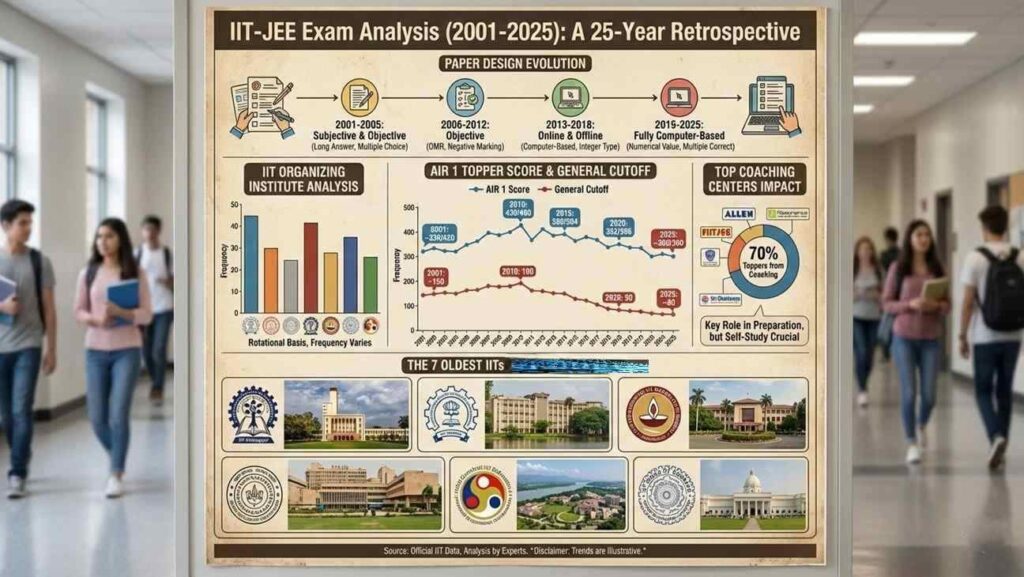
IIT-JEE Exam analysis: Paper Design last 25 years, IIT Organizing, AIR 1 Topper Score, general cutoff, and Top coaching center.
IIT-JEE (Advanced) Exam Analysis (Last 25 Years): Exam design includes paper pattern, organizing body, best candidate for AIR 1, general cut-off score, topper marks score, core weighted subjects, topper exam strategy and tips, and coaching center analysis. This information provides a historically verified summary, including AIR 1 data from 2001 to 2025, category-wise cut-off scores, and the design of the IIT-JEE exam by the IIT organizers.
1. Yearly Overview: Toppers, Cutoffs, and Organizing IITs
| Year | Organizing IIT | AIR 1 Topper | Topper Marks | Cutoff (Gen) | Difficulty Level |
|---|---|---|---|---|---|
| 2025 | IIT Kanpur | Rajit Gupta | 332/360 | 76(21.1%) | Difficult |
| 2024 | IIT Madras | Ved Lahoti | 355 / 360 | 109 (30.2%) | Moderate-Difficult |
| 2023 | IIT Guwahati | V. Chidvilas Reddy | 341 / 360 | 86 (23.8%) | Moderate |
| 2022 | IIT Bombay | R.K. Shishir | 314 / 360 | 77 (21.3%) | Very Difficult |
| 2021 | IIT Kharagpur | Mridul Agarwal | 348 / 360 | 63 (17.5%) | Difficult |
| 2020 | IIT Delhi | Chirag Falor | 352 / 396 | 69 (17.4%) | Moderate-Difficult |
| 2019 | IIT Roorkee | Kartikey Gupta | 346 / 372 | 93 (25.0%) | Moderate |
| 2018 | IIT Kanpur | Pranav Goyal | 337 / 360 | 90 (25.0%) | Moderate |
| 2017 | IIT Madras | Sarvesh Mehtani | 339 / 366 | 128 (35.0%) | Easy-Moderate |
| 2016 | IIT Guwahati | Aman Bansal | 320 / 372 | 75 (20.0%) | Difficult |
| 2015 | IIT Bombay | Satvat Jagwani | 469 / 504 | 177 (35.1%) | Moderate |
| 2014 | IIT Kharagpur | Chitraang Murdia | 334 / 360 | 126 (35.0%) | Moderate |
| 2013 | IIT Delhi | P. Sai Sandeep Reddy | 332 / 360 | 126 (35.0%) | Moderate |
| 2012 | IIT Delhi | Arpit Agrawal | 385 / 401 | 150 (37.4%) | Moderate |
| 2011 | IIT Kanpur | Immadi Prudhvi Tej | 440 / 480 | 229 (47.7%) | Moderate |
| 2010 | IIT Madras | A. Jithendra Reddy | 441 / 489 | 190 (38.8%) | Moderate |
| 2009 | IIT Guwahati | Nitin Jain | 425 / 480 | 178 (37.1%) | Moderate |
| 2008 | IIT Roorkee | Sitin Gupta | 433 / 480 | 172 (35.8%) | Difficult |
| 2007 | IIT Bombay | Achyut Nayak | 432 / 486 | 206 (42.3%) | Moderate |
| 2006 | IIT Kharagpur | Raghu Mahajan | 508 / 560 | 154 (27.5%) | Difficult |
| 2005 | IIT Kanpur | Piyush Srivastava | 544 / 600 | 191 (31.8%) | Moderate |
| 2004 | IIT Delhi | Sushant Sachdeva | 534 / 600 | 175 (29.1%) | Moderate |
| 2003 | IIT Madras | Shashank Dwivedi | 446 / 540 | 152 (28.1%) | Difficult |
| 2002 | IIT Roorkee | Dungara Ram Choudhary | 442 / 540 | 141 (26.1%) | Moderate |
| 2001 | IIT Bombay | Arvind Thiagarajan | 438 / 540 | 135 (25.0%) | Difficult |
2. Organizing & Paper Design Setting Mechanism
The Joint Admission Board (JAB) oversees the entire process, while one specific IIT acts as the “Zonal Coordinating Institute” or “Organizing Institute” for the rotation cycle of year.
- The Question Paper Committee: Contrary to popular belief, the organizing IIT doesn’t set all questions. A confidential committee of professors from all older IITs contributes. They gather in a secret location (often called the “Paper Setting Room”) for weeks without external contact.
- Multiple Sets: Usually, 2-3 complete sets of papers are finalized. The final selection of which set to use is made just hours before the exam to ensure maximum security.
- Unpredictability by Design: The organizing IIT defines the “flavor” of the year. For example, IIT Bombay (2022) is known for highly conceptual Physics, while IIT Kharagpur (2021) often focuses on multi-step calculations.
3. Long-Term Evolution and Institutional Cycles
- The “Bansal Era” (2001-2008): Bansal Classes in Kota was the undisputed leader, producing AIR 1 almost every year during this period.
- Transition to Multi-Correct/Numerical: The exam shifted from a purely subjective/objective mix to a heavy focus on multi-correct and integer-type questions in the 2010s to minimize guessing and reward precision.
- Organizing Cycles: The “Older 7 IITs” rotate the responsibility to filter quality of student to conducting the exam every year in a fixed sequence: Roorkee, Madras, Bombay, Kanpur, Kharagpur, Delhi, and Guwahati.
4. Top Institutes & Coaching Powerhouses
Top Coaching Centers
- Allen Career Institute (Kota): Currently the largest in terms of student volume and top-100 ranks.
- FIITJEE: Known for its rigorous internal testing (AITS) which mimics the “Difficult” JEE years.
- Sri Chaitanya / Narayana: Dominant in South India; famous for the “Micro-schedule” approach.
- Resonance / Reliable: Kota-based offshoots with a heavy focus on core conceptual material.
Target IIT Rankings (NIRF 2024)
- IIT Madras: Consistently ranked #1 globally/nationally for Engineering and innovation .
- IIT Delhi: Preferred for Computer Science and startup culture.
- IIT Bombay: The top choice for AIR 1-50 (specifically CS and EE).
- IIT Kanpur: Renowned for its academic rigor and pure science/research focus.
5. Pattern & Paper Setting Analysis
Question Typology
- MCQs: Single and Multiple Correct Options (Partial Marking is common).
- Numerical Value: Integer or Decimal type with no negative marking.
- Matching List: Complex matrices (e.g., 3×3 or 4×4 matching).
- Comprehension: Passage-based questions requiring deep context and multi-step logic.
Paper Trends
- Unpredictability: Total marks and number of questions change every year.
- Negative Marking: Extremely high stakes; often -2 for incorrect MCQs, penalizing guesswork.
- Partial Marking: Crucial for rank; allows scoring even if only a subset of correct options is selected.
6. Subject-Wise Mastery & Weightage
High-Weightage: Mechanics & Electrodynamics
Avoid Rote Learning: Focus on deriving formulas from first principles rather than memorizing edge cases. Mechanics and Electrodynamics usually form 50%+ of the paper.
Modern Physics: High reward-to-effort ratio; usually straightforward but carries significant marks.
- Core Topics: Rotation, Ray Optics, Thermodynamics, Current Electricity.
- Scoring Tip: Focus on ‘Visualizing’ the problem before applying equations.
- Resource: Use “Irodov” selectively and “Krotov” for challenging theoretical experiments.
High-Weightage: Organic & Physical Chemistry
Physical: High focus on Thermodynamics and Kinetics; mathematical accuracy and unit conversions are key.
Organic: Understand mechanisms (GOC, Reaction intermediates) over specific reaction memorization.
Inorganic: NCERT is the essential resource for Metallurgy, p-block, and Coordination Compounds.
- Core Topics: Equilibrium, Carbonyl Compounds, Metallurgy, Solid State.
- Scoring Tip: Chemistry is the fastest subject; finish it in 45-50 mins to save time for Maths/Physics.
High-Weightage: Calculus & Algebra
Calculus & Vectors: Always 30-35% of the paper. Clear fundamentals and speed in integration make these high-scoring.
The Multi-Correct Trap: Use “Elimination by Counter-example” to quickly discard similar-looking options.
Coordinate Geometry: Lengthy but follows predictable logic; great for securing sure-shot marks.
- Core Topics: Definite Integration, Vectors & 3D, Probability, Matrices.
- Scoring Tip: Skip “Speed Breakers” (questions that take >5 mins) to maintain psychological momentum.
7. Topper’s Execution & Scoring strategy
Preparation Routing
- Concept > Coverage: Advanced tests depth. smart plans 70% of the syllabus deeply is better than 100% shallowly.
- Error Log: Maintain a diary of “Silly Mistakes” and “Conceptual Gaps” from every single mock test.
- Simulation Training: Align your biological clock by testing at actual exam timings (9-12 and 2:30-5:30) for months.
- PYQ Analysis: Solve 20+ years of papers to internalize the “IIT Mindset.”
Exam Day Tactics
- The “Two-Pass” Method: First pass for easy/medium (90 mins), second pass for complex/multi-correct problems.
- Marking Scheme Vigilance: Spend 2 mins reading the marking scheme; it changes every year and determines your risk level.
- The 5-Minute Scan: Quickly identify “sitters” in Chemistry to gain early confidence.
- Zero Guesswork: In -2 marking years, an unattempted question is a victory over a wrong guess.
Q-How many IIT institutes are there in India till now and what is their ranking and specialization?