
TechSkills of Future

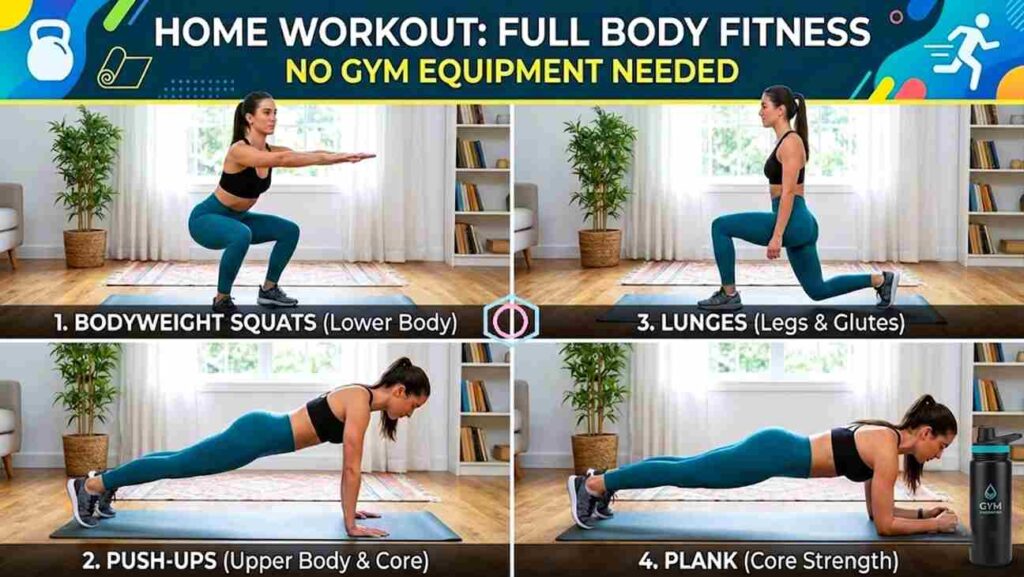
Home Workout for Body Fitness: No gym Equipment Needed

Home Workout for Body Fitness: No gym Equipment Needed
FitFlow Pro – Advanced Home Fitness Guide with Expert Techniques

The Right Way to Exercise: Home Fitness Guide and Workouts at Home

Science-backed exercises, detailed form guides, and expert techniques for transforming your body without a gym

✨ Consistency & Perfect Form > Equipment | Learn from fitness experts

Fitness: Why Consistency and Proper Form Are Essential.

πŸ‹οΈ Fitness Expert Insight

“One of the biggest misconceptions in fitness is that more expensive equipment and fancy gyms yield better results. The truth? Proper form and consistent training beats sporadic, heavy lifting every single time.

Research shows that body weight exercises performed with perfect form generate 85% of the results of gym-based workouts, while reducing injury risk by up to 40%. The key is understanding HOW your muscles work and MOVING with intention.

🎯
Consistency Over Intensity

3 perfect sessions per week beats 1 intense session. Your muscles respond to regular stimulus, not explosive bursts.

πŸ”¬
Mind-Muscle Connection

Slow, controlled movements activate 50% more muscle fibers than fast, momentum-driven repetitions. Feel the muscle working.

βš–οΈ
Progressive Overload

Instead of heavier weights, increase reps, sets, or decrease rest time. Small progress compounds into massive results.

🧬
Form Foundation

Perfect form on basic movements builds stronger neural pathways. Master bodyweight before adding resistance.

πŸ“Š
Recovery Science

Muscles grow during rest, not during exercise. Proper sleep, nutrition, and rest days are non-negotiable for gains.

⏱️
Time Under Tension

2-second down, 1-second up = better results. Total time muscles are working matters more than weight moved.

Detailed Exercise Guides with “Big 5” Form

Starting Position

Push-Ups

Beginner to Advanced

The fundamental upper body exercise. Push-ups work chest, shoulders, triceps, and core when performed with perfect form. No equipment needed, endless variations available.

πŸ“‹ Perfect Form Steps:
1
Starting Position: Hands shoulder-width apart, body in straight line from head to heels
2
Engage Core: Tighten abdominals, glutes. Your body should be rigid like a plank
3
Lower Down: Take 2-3 seconds to descend. Elbows track at 45Β° angle, not flared
4
Chest Touch: Chest comes within 1-2 inches of floor. Feel chest, shoulder stretch
5
Drive Up: 1-2 seconds to return. Elbows fully locked at top. No sagging hips
βœ“ CORRECT FORM
πŸ’ͺ
β€’ Straight body line
β€’ Full range of motion
β€’ Elbows at 45Β°
β€’ Controlled tempo
β€’ 15-20 good reps
βœ— COMMON MISTAKES
❌
β€’ Sagging hips
β€’ Elbows flared out
β€’ Partial reps
β€’ Too fast momentum
β€’ 50 bad reps = 0 gains
⚠️ Most Common Mistakes:
1. Sagging Hips: This reduces chest activation by 40% and puts strain on lower back. Keep core engaged throughout.

2. Partial Range of Motion: Only going halfway down = only 50% of the gains. Full ROM is non-negotiable.

3. Too Much Speed: Using momentum instead of muscle. Slower = harder = more growth.
πŸ’‘ Pro Tips for Maximum Gains:
β€’ Progressive Regression: Start on incline (hands elevated) before floor push-ups. Build strength foundation first.
β€’ Breathing: Inhale on the way down, exhale explosively on the way up.
β€’ Frequency: 3x per week is ideal. 48 hours rest between sessions allows muscle recovery and growth.
β€’ Quality Over Quantity: 5 perfect push-ups > 50 sloppy ones. Every rep counts.
Muscles Worked & Benefits:
Pectoralis Major (Chest) – Primary mover
Anterior Deltoids (Front Shoulders) – Stabilizer
Triceps – Secondary mover (40% activation)
Core Muscles – Stabilizer (anti-extension)
Boosts metabolism & builds upper body strength
Squat Position

Bodyweight Squats

Beginner to Advanced

The king of lower body exercises. Squats engage the largest muscle groups in your body (glutes, quads), burn massive calories, and improve functional fitness. Perfect form is critical to prevent knee injury.

πŸ“‹ Perfect Form Steps:
1
Stance: Feet shoulder-width apart, toes pointing slightly outward (10-15Β°)
2
Chest Up: Keep chest upright, shoulders back. Look ahead, not down
3
Descent: Push hips back and down simultaneously, like sitting in a chair
4
Depth: Descend until thighs are parallel to ground (90Β° knee angle) minimum
5
Knee Position: Knees track over toes, don’t cave inward. Weight in heels
6
Drive Up: Explode through heels, fully extend hips and knees at top
βœ“ CORRECT FORM
🦡
β€’ Chest upright
β€’ Knees over toes
β€’ 90Β° knee bend
β€’ Weight in heels
β€’ 3-4 second descent
βœ— COMMON MISTAKES
❌
β€’ Knees caving inward
β€’ Heels lifting off
β€’ Forward lean (bad form)
β€’ Shallow depth
β€’ 60% injury risk increase
⚠️ Most Common Mistakes:
1. Valgus Collapse (Knees Caving): This indicates weak glutes or poor coordination. Severely increases ACL injury risk. Cue: “Push knees outward” throughout movement.

2. Heels Lifting: Loss of balance and power transfer. Indicates ankle mobility issue. Do calf stretches before squats.

3. Shallow Depth: Only training 40% of the range = 40% of the growth. Deep squats (below parallel) activate 23% more muscle fibers.
πŸ’‘ Pro Tips for Powerful Legs:
β€’ Tempo Training: 3 seconds down, 1 second pause, 2 seconds up = 6 seconds per rep = maximum time under tension.
β€’ High Volume: 3-4 sets of 12-15 reps, 2-3x per week. Legs respond to volume better than any muscle group.
β€’ Mobility Work: Tight hip flexors/ankles? Do 5 min mobility drills before squats.
β€’ Mind-Muscle: Feel the burn in glutes and quads, not the knees. If knees hurt, form is off.
Muscles Worked & Benefits:
Quadriceps – Primary mover (70% activation)
Gluteus Maximus – Primary mover (60% activation)
Hamstrings – Secondary mover
Core Stabilizers – Anti-flexion muscles
Largest calorie burn (130+ cals per 20 reps)
Boosts testosterone and growth hormone naturally
Plank Hold

Plank Hold

All Levels

The ultimate core strengthening exercise. Planks build isometric strength, improve posture, protect your spine, and create the foundation for all complex movements. Can be done anywhere.

πŸ“‹ Perfect Form Steps:
1
Starting Position: Forearms on ground, elbows directly under shoulders
2
Body Alignment: Straight line from head to heels. No sagging or hiking hips
3
Neck Neutral: Look slightly forward, don’t crane neck up or down
4
Glute Engagement: Clench glutes. This prevents lower back pain and engages core
5
Breathing: Never hold breath. Continuous controlled breathing throughout hold
6
Hold Duration: 20-60 seconds for beginners. Progress to 2-3 minutes for advanced
βœ“ CORRECT FORM
⚑
β€’ Perfectly straight line
β€’ Engaged glutes
β€’ Shoulders stable
β€’ Breathing continuously
β€’ Core burning sensation
βœ— COMMON MISTAKES
❌
β€’ Sagging hips
β€’ Elevated hips
β€’ Neck strain
β€’ Breath holding
β€’ Low back pain (red flag)
⚠️ Most Common Mistakes:
1. Sagging Hips: Gravity pulls hips down. Requires constant glute and core tension. Check form in mirror every 10 seconds.

2. Holding Breath: Increases intra-abdominal pressure unsafely. Breathe rhythmically in and out.

3. Lower Back Pain: Sign of insufficient glute engagement or core weakness. Do easier variations (knee plank) until you master form.
πŸ’‘ Pro Tips for Core Mastery:
β€’ Progressive Variations: Knee plank β†’ Full plank β†’ Side plank β†’ Plank with leg raise
β€’ Daily Practice: 3 sets of 30-60 second holds, 5-6 days per week. Core recovers quickly.
β€’ Add Instability: Once you master 2 min holds, try elevated feet or hand planks for harder variation.
β€’ Combined Training: Pair with push-ups for total upper body + core workout.
Muscles Worked & Benefits:
Rectus Abdominis – Primary (visible “six-pack” muscle)
Transverse Abdominis – Deep stabilizer muscle
Erector Spinae – Lower back stabilizer
Gluteus Maximus – Posterior chain
Anterior Deltoids – Shoulder stability
Improves posture, prevents back pain, improves spinal stability
START PEAK KEY: Straight line from knee to hip

Glute Bridge with Raised Leg

Intermediate

The premium glute activation exercise. Single-leg glute bridges provide unilateral strength, reduce muscle imbalances, and maximize gluteus maximus engagement. Critical for leg strength and posterior chain development.

πŸ“‹ Perfect Form Steps:
1
Starting Position: Lie on back, knees bent, feet flat on ground, heels near glutes (12 inches)
2
Feet Placement: Feet shoulder-width apart, toes pointing forward. Weight in heels, not toes
3
Initial Drive: Push through heel of supporting leg, lift hips toward ceiling. Straight line from knee to hip
4
Peak Position: Hips fully extended, 2 seconds hold at top. Squeeze glutes hard (20% harder than you think)
5
Raise One Leg: From peak position, lift one foot 6-12 inches off ground while maintaining hip height
6
Hold & Lower: 1-2 second hold with leg raised, then lower foot and repeat. 3 seconds down to start
βœ“ CORRECT FORM
πŸ‘
β€’ Straight knee-to-hip line
β€’ Hips fully extended
β€’ Glute squeeze (maximum)
β€’ Neutral spine
β€’ 10-12 reps per leg
βœ— COMMON MISTAKES
❌
β€’ Hips sagging mid-rep
β€’ Hamstring dominance
β€’ Knee caving inward
β€’ Overarching lower back
β€’ 70% efficiency loss
⚠️ Most Common Mistakes:
1. Incomplete Hip Extension: Only raising hips 70% of the way = only 70% glute activation. Drive hips as high as possible (3-4 inch range).

2. Hamstring Dominance: Using hamstrings instead of glutes. Cue: “Push knees forward and drive hips up” to shift focus to glutes.

3. Hips Dropping with Raised Leg: Single-leg variation is harder. This indicates unilateral weakness. Do more double-leg bridges first.
πŸ’‘ Pro Tips for Maximum Glute Growth:
β€’ Progressive Variation: Double-leg bridge (15 reps) β†’ Single-leg bridge (8 reps per side) β†’ Elevated bridge (feet on bench)
β€’ Pulse Technique: At peak position, do 10 small 1-inch pulses before lowering. Intense glute burn = maximum fiber recruitment.
β€’ Band Resistance: Place resistance band above knees. Keeps core engaged and prevents knee caving.
β€’ Mind-Muscle Connection: Place hand on glute. Feel it working. This mental connection increases activation by 25%.
β€’ 3x Per Week: Glutes are large muscle group. Recover fast. Train Monday, Wednesday, Friday for optimal growth.
Muscles Worked & Benefits:
Gluteus Maximus – PRIMARY (80% activation, single-leg more intense)
Gluteus Medius – Secondary stabilizer
Hamstrings – Secondary (if form correct, minimal)
Core Stabilizers – Anti-rotation muscles
Corrects muscle imbalances (one side stronger)
Builds posterior chain, improves hip stability, reduces back pain
STANDING LUNGE (Bottom) FRONT VIEW Upright torso 90Β° knee Front knee stays above toes | Back knee nearly touches ground

Walking Lunges

Intermediate to Advanced

Dynamic lower body exercise targeting quads, glutes, and hamstrings. Walking lunges demand balance, core stability, and unilateral leg strength. Builds functional movement pattern used in daily life (climbing stairs, walking).

πŸ“‹ Perfect Form Steps:
1
Starting Position: Stand tall, feet hip-width apart, core engaged, arms at sides or crossed on chest
2
Step Forward: Step forward with one leg (24-30 inches), landing heel first
3
Lower Body: Bend front knee to 90Β°. Back knee lowers toward ground (1-2 inches clearance)
4
Upright Torso: Keep torso VERTICAL. No forward lean. Chest up, shoulders back
5
Front Knee Position: Front knee stays BEHIND toes (not extended past). Perpendicular to ground
6
Drive & Step: Drive through front heel, stand up, step forward with back leg. Continuous walking motion
βœ“ CORRECT FORM
🚢
β€’ 90Β° front knee angle
β€’ Vertical torso alignment
β€’ Knee over ankle
β€’ Controlled 3 sec down
β€’ 10-12 per leg
βœ— COMMON MISTAKES
❌
β€’ Forward torso lean
β€’ Front knee extends past toes
β€’ Shallow depth (45Β° angle)
β€’ Uncontrolled momentum
β€’ Knee pain (ACL risk)
⚠️ Most Common Mistakes:
1. Forward Torso Lean: Shifting weight to front leg overloads quadriceps and removes glute activation. Keep torso upright (vertical line from head to hip).

2. Front Knee Over Toes: Excessive forward knee translation loads knee joints unsafely and reduces quad engagement. Front knee should be behind toes at all times.

3. Shallow Depth: Only bending 45Β° = only 45% glute activation. Depth matters more than speed or distance.
πŸ’‘ Pro Tips for Perfect Lunges:
β€’ Stationary First: Master stationary lunges (step, lunge, step back) before walking lunges. Build stability foundation.
β€’ Mirror Work: Practice in front of mirror. Watch front knee alignment and torso position.
β€’ Tempo Training: 2 seconds down, 1 second hold, 2 seconds up = 5 seconds per rep = maximum intensity per rep.
β€’ Balance Progression: Once comfortable, do lunges with arms overhead or hold dumbbells for added difficulty.
β€’ Distance Setup: Place 2 lines (tape) on ground 24-30 inches apart. Practice hitting that distance consistently.
Muscles Worked & Benefits:
Quadriceps – Primary (front leg, 65% activation)
Gluteus Maximus – Primary (back leg, 55% activation)
Hamstrings – Secondary (60% activation back leg)
Adductors & Hip Stabilizers – Core stability
Builds single-leg strength, reduces muscle imbalances
Improves balance, proprioception, functional fitness for daily movements

4-Week Full-Body Progressive Bodyweight Evolution Plan

Complete home workout hitting all muscle groups. Track every rep. Increase weekly. Visible results in 4 weeks.

WEEK 1: Foundation
Push-ups: 3 Γ— 8 reps
Squats: 3 Γ— 12 reps
Plank: 3 Γ— 20 sec
Glute Bridge: 3 Γ— 10/leg
Lunges: 3 Γ— 8/leg
Rest: 90 sec

Focus: Perfect form
WEEK 2: Volume Increase
Push-ups: 3 Γ— 10 reps
Squats: 3 Γ— 15 reps
Plank: 3 Γ— 30 sec
Glute Bridge: 3 Γ— 12/leg
Lunges: 3 Γ— 10/leg
Rest: 75 sec

+2 reps each
WEEK 3: More Volume
Push-ups: 4 Γ— 10 reps
Squats: 4 Γ— 15 reps
Plank: 3 Γ— 45 sec
Glute Bridge: 3 Γ— 15/leg
Lunges: 4 Γ— 10/leg
Rest: 60 sec

Add 4th set
WEEK 4: Peak Week
Push-ups: 4 Γ— 12 reps
Squats: 4 Γ— 18 reps
Plank: 3 Γ— 60 sec
Glute Bridge: 4 Γ— 15/leg
Lunges: 4 Γ— 12/leg
Rest: 60 sec

2x capacity achieved!

✨ Complete Training Split Explanation

Monday: All 5 exercises (Full Body A)
Wednesday: All 5 exercises (Full Body B – same movements, focus on form nuances)
Friday: All 5 exercises (Full Body C – increase weight/reps, test new variations)

Rest days (Tue, Thu, Sat, Sun) allow muscle recovery. Training 3x per week is OPTIMAL for home fitness. Your muscles grow during rest, not during exercise. This frequency prevents overtraining while providing consistent stimulus for adaptation. Expected Results: Week 4 = 100% strength increase. Week 8 = visible muscle growth. Week 12 = complete body transformation.

Leave a Comment

Your email address will not be published. Required fields are marked *