1. The Core Synergy
Cloud computing provides the agility and scalability that DevOps requires to function effectively. Without the cloud, the “Operations” side of DevOps would still be hampered by manual hardware provisioning and physical data center constraints.
| Feature | How Cloud Enables DevOps |
|---|---|
| On-Demand Resources | Allows teams to spin up test environments instantly. |
| Scalability | Automated scaling ensures applications meet demand without manual intervention. |
| Global Reach | DevOps pipelines can deploy code to multiple regions simultaneously. |
| Cost Management | Pay-as-you-go models align with experimental, iterative DevOps cycles. |
2. Key DevOps Practices in the Cloud
Modern DevOps relies on specific technical pillars that are native to cloud environments:
CI/CD Pipelines
Automated pipelines take code from a developer’s machine to production. In 2026, these are increasingly AI-enhanced with predictive failure analysis.
Infrastructure as Code (IaC)
Infrastructure is treated as application code. Tools like Terraform and Pulumi allow versioning of the entire cloud stack.
Microservices & Containers
Breaking monoliths into independent services. Kubernetes and Docker/Podman facilitate massive scalability.
DevSecOps
Security is “shifted left,” integrating vulnerability scanning and compliance checks into the earliest stages of development.
Full-Stack Observability
Moving beyond simple monitoring to distributed tracing, log aggregation, and real-time telemetry using OpenTelemetry.
Chaos Engineering
Intentionally introducing failures into cloud systems to test resilience and ensure high availability in unpredictable environments.
3. Site Reliability Engineering (SRE) vs. DevOps
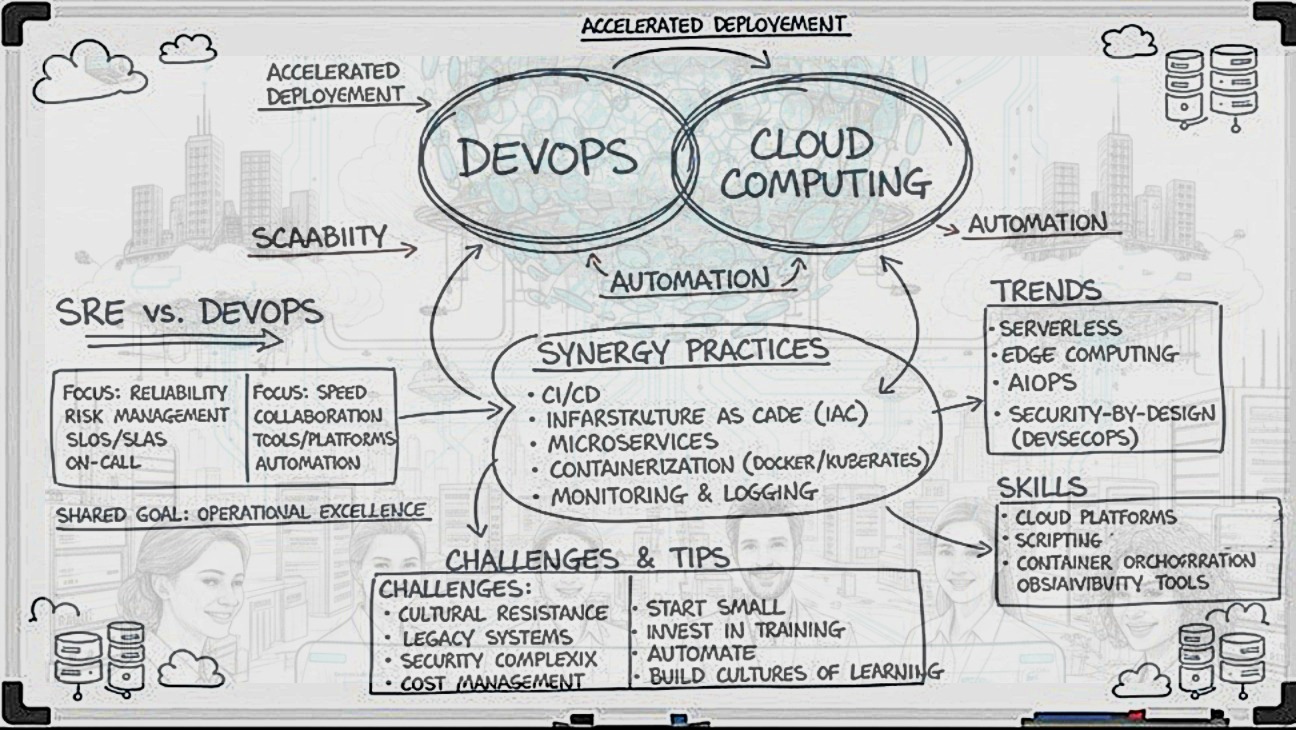
In 2026, organizations have matured to understand that while DevOps is a philosophy, SRE is the implementation. SRE teams use software engineering mindsets to solve operational problems.
DevOps Focus
- Breaking down silos
- Embracing failure as learning
- Automating everything
- Continuous delivery
SRE Focus
- SLIs, SLOs, and Error Budgets
- Reducing “Toil” (manual work)
- Change Management
- Incident Response/Post-mortems
4. Emerging Trends for 2026
Platform Engineering & IDPs
Centralized teams build “Golden Paths”—pre-approved workflows that allow developers to self-serve infrastructure while maintaining governance.
GreenOps (Carbon-Aware Computing)
DevOps teams monitor carbon intensity. Automated pipelines schedule non-critical jobs during “low-carbon” hours of the power grid.
Software Supply Chain Security (SLSA)
Focusing on SBOMs (Software Bill of Materials). In 2026, every build must prove its provenance and integrity to reach production.
Cloud-to-Edge DevOps
Extending CI/CD to Edge devices. DevOps teams now manage code deployments to decentralized IoT nodes and regional edge caches simultaneously.
Sovereign Cloud & Compliance-as-Code
Automated governance ensuring data never leaves geographic boundaries, meeting strict GDPR 2.0 and local sovereignty standards.
5. Essential Skills for the 2026 Cloud Professional
Technical Core
Cloud Strategy
Adaptive Skills
6. Challenges, Additional Risks, and Tips
Major Challenges
Tooling Complexity Gap
The explosion of the CNCF landscape has created “cognitive overload” for engineers. Managing 20+ tools in a single pipeline is becoming unsustainable.
Technical Debt in IaC
Legacy Terraform scripts and unmaintained Helm charts are becoming the “new technical debt,” harder to migrate than application code.
Stateful Data in Serverless
Managing database connections and consistent state in highly ephemeral serverless environments remains a significant architectural hurdle.
Implementation Tips
Automate Documentation
Use tools that generate architecture diagrams and docs directly from your IaC code to ensure they never go out of date.
Implement Error Budgets
Don’t just aim for 100% uptime. Define clear Error Budgets to allow your team to innovate faster without fearing failure.
Shift-Left Everything
Don’t just shift security; shift performance testing and cost estimation into the PR process using automated bots.
Talent & Culture Best Practices
Move from a “Hero Culture” to a “Process Culture.” High-performing teams share knowledge through documentation and automated playbooks, reducing the “Bus Factor.”
Multi-Cloud Portability
Avoid vendor-specific services for critical logic. Use open-source standards (OCI, CNCF) to maintain the ability to migrate if costs or regulations change.