
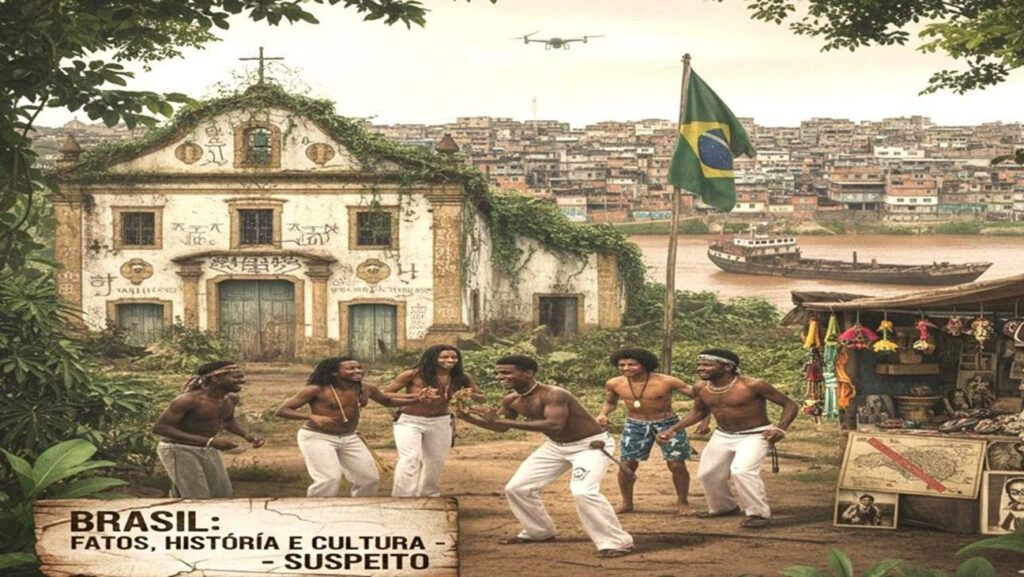
BRASIL: The Giant of South America
A concise overview of Brazil’s biodiverse ecosystems and global influence as the world’s 5th -largest country.
Foundational Knowledge
Geographic & Demographic Profile
- Continental Size: 5th largest country globally by area (over 8.5 million km²) and 7th by population (over 215 million).
- Unique Borders: Brazil shares land borders with every South American country except Chile and Ecuador, totaling 10 nations.
- Coastline: Possesses a vast Atlantic coastline spanning over 7,491 kilometers, crucial for its trade and tourism.
- The Planned Capital: Brasília (the capital) was built in just 41 months (1956–1960) and is recognized for its unique modernist architecture.
- Language Uniqueness: Portuguese is the official language, making it a linguistic island in Spanish America. The language has distinct Brazilian dialects.
From Colony to Republic
- Colonial Name: The land was initially named Ilha de Vera Cruz (Island of the True Cross) by the Portuguese explorer Pedro Álvares Cabral in 1500.
- Slavery’s Depth: Brazil imported an estimated 4.9 million enslaved Africans, far more than any other nation in the Americas, shaping its deep racial and cultural complexity.
- Unique Transition: Unlike many Latin American neighbors, Brazil gained independence (1822) without mass bloodshed, transitioning to a Monarchy (the Empire of Brazil) rather than a republic.
- The Old Republic: The monarchy was peacefully overthrown in a military coup in 1889, establishing the Federative Republic, though political stability has been a continuous process.
Culture, Arts, and Identity
Artistic and Social Heritage
- Carnival Spectacle: The Carnival in Rio de Janeiro is not just a party; it is a serious competition for the Samba Schools, where parades are judged on complex criteria, including costume, song, and choreography.
- The Sound of Brazil: Beyond Samba and Bossa Nova, Brazil’s musical landscape includes Forró (Northeast folk dance music) and Sertanejo (country music), which is the most commercially successful genre today.
- Gastronomy Highlight: Acarajé, a deep-fried patty of black-eyed peas and onions served with shrimp and pepper sauce, is a UNESCO-recognized food tradition from the Afro-Brazilian culture of Bahia.
- Religious Diversity: While predominantly Catholic, Brazil has a strong blend of African-derived religions like Candomblé and Umbanda, reflecting its profound cultural synthesis.
The Global Sporting Colossus
- The Pentacampeões: Brazil is the only nation to have won the FIFA World Cup five times (1958, 1962, 1970, 1994, 2002), a record unmatched in international football.
- Home of Legends: It produced the world’s most famous footballing icons, including Pelé (considered by many the greatest) and Ronaldo Nazário.
- Beyond Football: Brazilian excellence extends to Formula 1 (with legendary drivers like Ayrton Senna), Volleyball (a consistent Olympic powerhouse), and Mixed Martial Arts (origin of BJJ).
- Host Nation: Brazil holds the distinction of having hosted two of the world’s largest sporting events in quick succession: the FIFA World Cup (2014) and the Summer Olympics (2016 in Rio).
Economic Power & Innovation
Macroeconomics and Trade
- Economic Status: Brazil is the largest national economy in Latin America and the 12th largest in the world (by GDP), making it a significant regional and global player.
- Agricultural Giant: It is the world’s largest producer and exporter of coffee, sugarcane, and oranges, and a leading exporter of soy and beef. This sector is a backbone of the economy.
- Industry Hub: The country boasts a diverse and advanced industrial base, including significant manufacturing in automobiles, aircraft (Embraer is a global leader), and chemicals.
- Oil & Gas: Brazil is a major oil producer, with significant offshore pre-salt reserves, contributing to its energy independence.
Innovation and Global Impact
- Aviation Pioneer: Alberto Santos-Dumont is a key figure in early aviation. His 14-bis aircraft made a successful public, engine-powered flight in Europe in 1906.
- Musical Revolution: Bossa Nova, created by artists like João Gilberto and Antônio Carlos Jobim, blended Samba with jazz harmony, fundamentally influencing global music in the 1960s.
- Sustainable Fuel: Brazil’s ethanol program, driven by sugarcane, began in the 1970s and serves as a global model for large-scale, sustainable biofuel infrastructure.
- Martial Arts Evolution: Brazilian Jiu-Jitsu (BJJ), refined by the Gracie family, emphasizes leverage and technique over strength, fundamentally changing the landscape of combat sports worldwide.
Mystery, Mythology, and the Unexplained
The Quest for the Lost City of Z
- Colonel Fawcett: In 1925, British explorer Percy Fawcett vanished in the Mato Grosso region while searching for a supposed ancient, highly advanced lost civilization he called “Z,” fueling decades of speculative search.
- Advanced Societies: Archaeological findings, like those at Kuhikugu, now confirm that large, complex societies (pre-Columbian urbanism) did exist in the Amazon, lending credence to the “Lost City” legends.
Uncontacted Peoples of the Rainforest
- A Modern Mystery: Brazil is home to the largest number of uncontacted tribes in the world (over 100 groups). Their continued isolation is protected by the government (FUNAI).
- Protective Isolation: These groups maintain an autonomous existence deep within the Amazon, serving as a powerful boundary against logging and resource exploitation in sensitive territories.
● Boto: The Enchanted Dolphin
Amazonian legend says the Pink River Dolphin (Boto) transforms into a handsome man at night to charm women at festivals, returning to the river before dawn.
● Curupira: Guardian of the Woods
A mythological creature with bright red hair and feet turned backward. The Curupira protects the forest from hunters by creating illusions and misleading tracks.
Brazil’s Six Major Biomes: Biodiversity Hotspots
● The Amazon Basin
The world’s largest tropical rainforest and river system. It covers over 40% of Brazil’s total area and contains approximately 10% of the world’s known species.
● The Pantanal Wetlands
The world’s largest tropical wetland. It is a highly seasonal system, home to the greatest concentration of wildlife in South America, including the highly elusive jaguar.
● The Cerrado Savanna
Known as the “Reverse Forest,” this massive savanna biome boasts deep-rooted trees and is recognized as the most biologically rich savanna in the world.
● Atlantic Forest (Mata Atlântica)
A highly endangered coastal forest with over 70% of its tree species found nowhere else. It stretches along the coast, near major population centers.
Man-made Marvels and Natural Wonders
Christ the Redeemer
Located on Corcovado Mountain in Rio, this Art Deco statue stands 30 meters tall and has become a universal symbol of the city and nation since 1931.
Iguaçu Falls
Part of a UNESCO World Heritage Site, this immense system features approximately 275 distinct cascades, making it one of the largest waterfall systems in the world.
Amazon River
The largest river by volume in the world, responsible for about one-fifth of the total volume of water discharged by rivers worldwide. It sustains the entire biome.
Brasília
An architectural masterpiece designed in the shape of an airplane (or a bird), featuring iconic structures like the National Congress, designed entirely by Oscar Niemeyer.