Digital Twin Technology: building living mirrors of physical assets
A digital twin is a continuously synchronized virtual replica of a physical asset, process, or system — fed by live sensor data, refined by simulation and AI, and used to predict, test, and optimize the real thing before problems ever reach the factory floor, the turbine, or the grid.
More than a 3D model — a synchronized, living system
A CAD model is frozen in time. A digital twin is not. It ingests live telemetry from its physical counterpart, updates its internal state continuously, and feeds insight back into the physical world — closing a loop that static models never could.
The Real Asset
The tangible factory, engine, bridge, or human body — instrumented with sensors that capture vibration, temperature, pressure, flow, position, and load in real time.
The Living Model
A physics-based or data-driven simulation that mirrors the asset’s geometry, behavior, and current condition — updated continuously as new data arrives.
The Data Bridge
The pipeline of sensors, edge gateways, networks, and APIs that keeps the two synchronized — bidirectionally, so insight can flow back as control commands.
NASA’s mission control used a physical mock-up of the Apollo 13 spacecraft on the ground to mirror conditions in orbit and test fixes before transmitting instructions — widely cited as the first practical digital-twin-like methodology, decades before the term existed. Michael Grieves formally introduced the “digital twin” concept in 2002 for product lifecycle management, and NASA’s John Vickers coined the term itself around 2010.
The closed feedback loop architecture
Every digital twin — regardless of industry — runs the same fundamental loop: sense, transmit, model, analyze, decide, and act. The loop never terminates; each cycle refines the twin’s accuracy.
Sense
IoT sensors and PLCs capture real-time physical signals — vibration spectra, thermal gradients, throughput, energy draw — at sampling rates from milliseconds to minutes depending on criticality.
Transmit
Edge gateways filter and compress data locally, then push it via MQTT, OPC-UA, or 5G/private-LTE to a cloud or on-prem data platform, reducing bandwidth and latency.
Contextualize
Raw telemetry is cleaned, time-aligned, and mapped onto the asset’s digital geometry and metadata — turning numbers into a coherent state representation.
Model & Simulate
The virtual model updates its state and runs physics-based or ML-based simulation to project forward — estimating remaining useful life, stress points, or throughput bottlenecks.
Decide
Analytics and AI layers surface anomalies, generate predictions, and evaluate “what-if” scenarios — a new load profile, a different maintenance schedule, an alternate production sequence.
Act
Recommendations or automated commands flow back to the physical asset — adjusting setpoints, scheduling maintenance, or re-sequencing a production line — closing the loop.
Four scales of digital twin
Digital twins are usually built hierarchically — twins of components roll up into twins of assets, which roll up into twins of whole systems and processes.
Component / Part Twin
The smallest building block — a virtual model of a single part, such as a turbine blade, a bearing, or a circuit board. Tracks material fatigue, stress concentration, and wear at the part level.
Asset Twin
A full machine or unit — an entire jet engine, a CNC machine, a wind turbine, a delivery truck. Combines multiple component twins into one coherent operating model.
System / Unit Twin
Models how multiple assets interact — an entire production line, a power substation, an aircraft’s interconnected engines and avionics. Reveals emergent behavior that single-asset twins miss.
Process Twin
The broadest scope — models entire end-to-end workflows: a factory’s full production schedule, a city’s traffic network, or a hospital’s patient flow. Optimizes across assets, people, and time.
Eight technologies that make twins possible
No single technology creates a digital twin — it’s the convergence of sensing, connectivity, computation, and intelligence layers working together.
???? IoT Sensors
Accelerometers, thermocouples, strain gauges, and flow meters generate the raw signal that grounds the twin in physical reality.
???? Edge Computing
Pre-processes data near the source — filtering noise and running lightweight inference before transmission, cutting latency for time-critical control loops.
???? 5G / Private LTE
Delivers the low-latency, high-density connectivity needed for thousands of sensors and millisecond-class control feedback on a factory floor.
☁️ Cloud / Hybrid Compute
Hosts the heavy simulation workloads, historical data lakes, and model training that on-prem hardware can’t economically scale to.
???? Physics & FEA Simulation
Finite element analysis and computational fluid dynamics engines model stress, thermal, and flow behavior with engineering-grade accuracy.
???? Machine Learning
Learns patterns physics models miss — degradation curves, anomaly signatures, and demand patterns — and continuously improves with new data.
???? AR / VR Interfaces
Lets engineers walk through the twin in mixed reality — overlaying live sensor data onto the physical asset for maintenance and training.
???? Interoperability Standards
ISO 23247, AAS (Asset Administration Shell), and OPC-UA give twins a common language to exchange data across vendors and platforms.
Anatomy of a factory digital twin
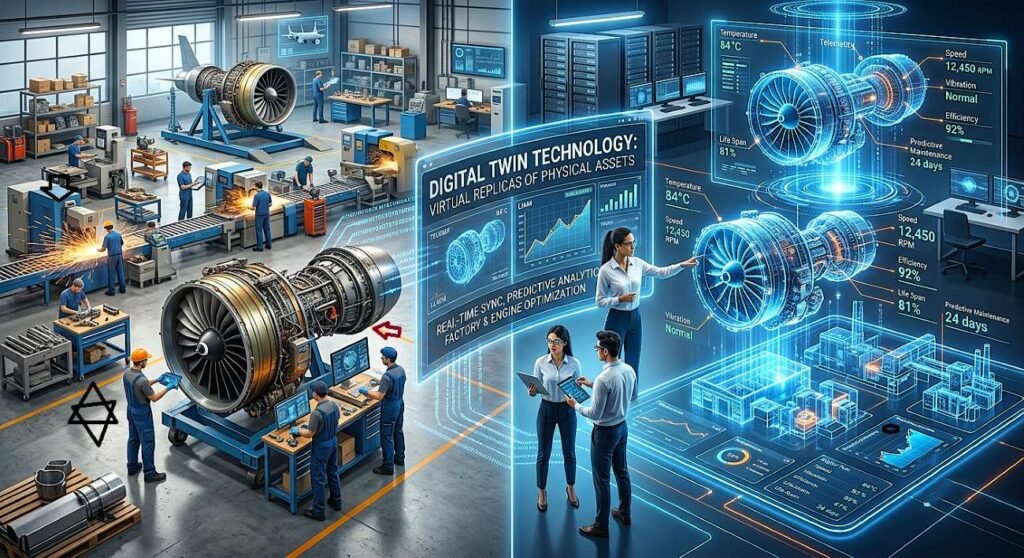
A factory twin layers sensor data from individual machines onto a full digital replica of the production line — enabling simulation of new layouts, bottleneck detection, and predictive maintenance before a single physical change is made.
BMW built a full virtual replica of its Regensburg plant in NVIDIA Omniverse before reconfiguring the physical line — testing robot placement and logistics flow in simulation, which the company reports cut planning time substantially while avoiding costly on-floor trial and error.
Anatomy of a jet engine digital twin
Aerospace twins are among the most mature in the world — every major commercial engine fleet now flies with a corresponding virtual twin that predicts wear on individual blades down to thousands of flight cycles in advance.
Rolls-Royce’s “IntelligentEngine” program streams engine health data from in-service aircraft and runs it through digital twins to forecast component wear, informing its long-running power-by-the-hour maintenance contracts rather than fixed inspection intervals.
Where digital twins are already at work
Beyond manufacturing and aerospace, the same loop — sense, model, predict, act — applies wherever a physical system is complex, expensive to experiment on, or safety-critical.
⚡ Energy & Power Grids
Utilities model substations and transmission networks to simulate load-shedding, renewable intermittency, and fault propagation before they hit the real grid. NTPC and several Indian DISCOMs have piloted twin-based load forecasting.
????️ Smart Cities
Singapore’s “Virtual Singapore” and similar city-scale twins simulate traffic flow, flood risk, and building energy use to test policy before implementation.
???? Healthcare
Patient-specific digital twins — built from imaging and wearable data — let clinicians simulate drug response or surgical outcomes before treating the real patient.
???? Automotive
Tesla and other OEMs maintain a digital twin for every vehicle sold, tracking battery degradation and component wear to schedule predictive service remotely.
????️ Construction & Buildings
BIM-linked twins track a building from design through construction into operations, optimizing HVAC, occupancy, and structural health over decades.
???? Maritime & Logistics
Shipping twins model hull fouling, engine efficiency, and route optimization, cutting fuel consumption across container fleets.
From dashboard to autonomous twin
Most organizations climb this ladder over years, not months — each rung requires deeper data quality, more advanced modeling, and greater organizational trust in the twin’s recommendations.
Descriptive Twin
A live 3D dashboard showing current sensor readings overlaid on the asset’s geometry. No prediction — pure visibility.
Informative Twin
Adds historical context and anomaly flags — alerting when a reading deviates from learned normal ranges.
Predictive Twin
Simulates forward in time to estimate remaining useful life, failure probability, or throughput under current trends.
Prescriptive Twin
Runs what-if scenarios and recommends specific actions — reroute this batch, replace this bearing in 12 days.
Autonomous Twin
Closes the loop without human approval for low-risk decisions — adjusting setpoints automatically within defined safety bounds.
Why is it difficult to create digital twins?
The concept is simple; the engineering is not. Most failed twin initiatives stall on these four problems.
| Challenge | Why it’s hard | Common mitigation |
|---|---|---|
| Data quality & latency | Sensor drift, missing data, and network jitter degrade model accuracy silently | Edge pre-validation, redundant sensing, data contracts |
| Interoperability | Legacy PLCs, proprietary protocols, and siloed vendor platforms resist integration | OPC-UA, Asset Administration Shell, middleware brokers |
| Cybersecurity | A bidirectional twin is a bidirectional attack surface into operational technology | Network segmentation, zero-trust, signed command pipelines |
| Model fidelity vs. cost | High-fidelity physics simulation is computationally expensive to run continuously | Hybrid physics + ML “surrogate models” for real-time use |
| Organizational trust | Operators hesitate to act on — or cede control to — a model they don’t understand | Explainable AI, staged autonomy rollout, audit trails |
Generative, multi-physics, and autonomous twins
The next wave shifts digital twins from passive mirrors to active collaborators in design and operations.
???? Generative Design Twins
Generative AI proposes and twin-simulates thousands of design variants overnight, narrowing to the handful worth physical prototyping.
???? Industrial Metaverse
Multiple twins — supplier factories, logistics networks, end products — link into shared persistent simulations for whole-supply-chain optimization.
???? Foundation Models for Twins
Large pretrained models fine-tuned on equipment telemetry generalize across asset types, reducing the data needed to stand up a new twin.
???? Closed-Loop Autonomy
Expanding autonomous-twin scope from single setpoints to entire production schedules adjusting themselves within human-defined guardrails.
???? Human Digital Twins
Personalized physiological twins built from wearables and imaging move from research into early clinical decision support.
???? Twin-of-Twins
Federated architectures where city, grid, and building twins exchange state — enabling cross-system resilience planning, e.g., grid response to extreme heat.
Glossary
- Digital ThreadThe traceable data chain linking an asset’s design, manufacturing, and operational records over its full lifecycle — the backbone a twin draws from.
- Surrogate ModelA fast-running approximation of an expensive physics simulation, trained on its outputs, used for real-time twin inference.
- OPC-UAAn open, platform-independent industrial communication standard widely used to move data between machines, twins, and enterprise systems.
- Asset Administration Shell (AAS)A standardized digital representation of an asset’s properties and capabilities, central to Industry 4.0 interoperability.
- Remaining Useful Life (RUL)The twin-predicted time or cycles before a component is expected to require maintenance or replacement.
- Digital ShadowA one-way data flow from physical to digital with no feedback loop back to the asset — a precursor stage to a full digital twin.
- ISO 23247The international standard defining a reference architecture for digital twins in manufacturing.