
SERVICE
COMMISSION **UPSC**
The UPSC Topper Ledger
Marks, Pattern & Strategy
A year-by-year record of the scores achieved by toppers in India’s civil services examinations is provided here. Additionally, since the exam pattern was changed this year, aspirants aiming to become officers should take these changes into account and tailor their preparation accordingly. The text also outlines how students can begin their UPSC preparation and build a strong foundation while still in Class 10 or during their undergraduate studies. Although the number of candidates appearing for the exam has risen in recent years, the number of those selected to become officers has remained very low. Along with details regarding the Prelims, Mains, interview, and final scores, a weekly strategy covering the entire process—from clearing the Prelims to facing the interview board—is also included.
The journey to becoming a civil servant, from hundreds of thousands of applicants.
UPSC CSE runs in three stages — Preliminary (screening, qualifying only), Main (written, merit-counting) and Personality Test/Interview (merit-counting). Only Mains + Interview marks decide your final rank; Prelims marks are never added to the merit list.
Mains call ratio
UPSC shortlists roughly 12 to 14 times the notified vacancies for the Mains exam. For 2025’s 979 notified posts, that produced 14,161 Mains qualifiers.
Total merit marks
Final rank is computed out of 2,025 — 1,750 from seven merit-counting Mains papers plus 275 from the Interview. Prelims marks play no role in this tally.
Recommended (2025)
317 General, 104 EWS, 306 OBC, 158 SC and 73 ST candidates were recommended, with 258 more on the reserve list and 348 provisional.
CSE 2025: Anuj Agnihotri, All India Rank 1
Result declared 6 March 2026. The exact paper-wise marksheet below is sourced from the official UPSC marks release.
MBBS, AIIMS Jodhpur (2023) · Hails from Rahata village, Jodhpur, Rajasthan · Was serving as a DANICS (Delhi, Andaman & Nicobar Islands Civil Service) probationer before this result · 3rd attempt · Optional subject: Medical Science
CSE 2025 — Top 5 All India Ranks
Written and Interview marks for the top rankers, as released in the official marksheet.
| AIR | Name | Background | Optional Subject | Written /1750 | Interview /275 | Total /2025 |
|---|---|---|---|---|---|---|
| 1 | Anuj Agnihotri | MBBS, AIIMS Jodhpur | Medical Science | 867 | 204 | 1071 |
| 2 | Rajeshwari Suve M | B.E. Electrical & Electronics, Anna Univ. | Sociology | 865 | 202 | 1067 |
| 3 | Akansh Dhull | B.Com, Delhi University | — | 864 | 193 | 1057 |
| 4 | Raghav Jhunjhunwala | B.A. (Hons) in Economics,Delhi University | Economics gold | 847 | 192 | 1042 |
| 5 | Ishan Bhatnagar | — | — | — | — | — (Top 5) |
| 62 | Tejaswini Singh | — | — | — | 225 (highest interview score) | — |
Ranks 5 Marks not accurately and also not on UPSC officail5 detailed paper-wise marks were not separately published in available result summaries at the time of writing — only Top 4 carry full breakdowns in this dossier.
Five-cycle topper comparison (2021 – 2025)
How AIR 1 scores, recommended candidate counts and result timelines have moved across the last few Year.
| Year | AIR 1 Topper | Total Marks /2025 | % | Recommended | Result Declared |
|---|---|---|---|---|---|
| CSE 2025 | Anuj Agnihotri | 1071 | 52.88% | 958 | 6 Mar 2026 |
| CSE 2024 | Shakti Dubey | 1043 | ≈51.5% | 1009 | 22 Apr 2025 |
| CSE 2023 | Aditya Srivastava | Not detailed here | — | 1016 | 16 Apr 2024 |
| CSE 2021 | Shruti Sharma | 1105 | 54.56% | 685 | Jun 2022 |
How the 2,025 marks are actually Score
Three stages, very different rules. Prelims is qualifying-only; Mains has two further qualifying papers that don’t count toward merit; only seven Mains papers plus the Interview decide your rank.
| Stage | Paper | Marks | Nature |
|---|---|---|---|
| Prelims | GS Paper I | 200 | Merit-deciding for Mains call (cutoff-based) |
| CSAT (GS Paper II) | 200 | Qualifying — min. 33% | |
| Mains | Paper A — Indian Language | 300 | Qualifying, not counted in merit |
| Paper B — English | 300 | Qualifying, not counted in merit | |
| Essay | 250 | Merit | |
| GS Paper I | 250 | Merit | |
| GS Paper II | 250 | Merit | |
| GS Paper III | 250 | Merit | |
| GS Paper IV (Ethics) | 250 | Merit | |
| Optional Paper I | 250 | Merit | |
| Optional Paper II | 250 | Merit | |
| Interview | Personality Test | 275 | Merit |
Changes in age, attempts, and the number of vacancies.
Age window
21 to 32 years as on 1 August of the exam year for the General category (born between 2 Aug 1993 and 1 Aug 2004 for CSE 2025). Upper limit is relaxed for OBC (+3), SC/ST (+5) and other reserved/special categories.
Attempts allowed
6 attempts for General/EWS, 9 for OBC and PwBD, and unlimited attempts (within the age window) for SC/ST candidates.
Educational qualification
A bachelor’s degree from a recognised university in any discipline. Final-year students may apply provisionally.
| Years | Vacancies notified | Candidates recommended |
|---|---|---|
| CSE 2021 | 712 (lowest in recent years) | 685 |
| CSE 2023 | ≈1,011–1,016 | 1,016 |
| CSE 2024 | ≈1,056–1,105 | 1,009 |
| CSE 2025 | 979 notified → 1,087 at result stage | 958 |
| CSE 2026 (notified) | 933 | in progress |
Vacancy figures are sometimes revised upward between the notification stage and the final result (additional posts, court directions, or service reallocation), which is why “notified” and “at result” numbers can differ for the same Year.
The last week before Prelims
This is revision week, not learning week. The goal is recall speed and error elimination — not new content.
Full-syllabus skim, not deep-read
Run through your own short notes for Polity, Economy, Geography, Environment and Static GK in one pass each. Do not open a new source this week — every new fact you add now is also a fact you might misremember on exam day.
Current affairs consolidation
Compress the last 12 months into a single revision sheet — government schemes, reports/indices, places in the news, and science & tech developments. Re-attempt your weakest 2 prior-year question sets.
Two full-length mock tests
One CSAT, one GS — under real timing. Review only the questions you got wrong due to silly mistakes (not knowledge gaps); fix the pattern, not the fact.
CSAT confidence pass
CSAT is qualifying at 33%, but every year some well-prepared GS candidates fail purely on CSAT. Solve one reasoning + one comprehension set to keep speed sharp.
Admit card, logistics, light revision only
Verify admit card, ID proof, exam centre route and reporting time. Light glance through your own one-page summary notes. No mock tests, no new topics. Sleep is now a syllabus item.
Attempt strategy
Solve the questions you’re certain of first, mark and skip ambiguous ones, and apply your own elimination threshold for guessing (given the 1/3rd negative marking) only in the final 15 minutes — don’t gamble early.
You think you’ve cleared Prelims — now what?
Don’t wait for the official result. Most successful candidates start Mains-mode the day they walk out of the Prelims hall, based on a self-assessed answer-key score.
Week 1 — Reset & plan
- Self-evaluate Prelims using unofficial answer keys; if you’re reasonably above last year’s cutoff, switch fully to Mains.
- Re-read the Mains syllabus line by line and map it against your existing notes — identify the gaps honestly.
- Lock your optional subject if not already decided; don’t switch optionals at this stage unless your current one is genuinely unworkable.
- Build a paper-wise study calendar for the ~10–12 weeks typically available before Mains.
Weeks 2–8 — Build & write
- Rotate daily across GS1–GS4 and the optional, rather than finishing one paper before starting the next.
- Daily answer writing is non-negotiable — start with 2–3 answers a day, scale to a full 20-question paper under timed conditions by week 6.
- Build a current-affairs-to-static linkage register (e.g., a scheme in the news mapped to its GS2/GS3 theme) — this is what separates a 60-mark answer from a 110-mark answer.
- Revise Ethics (GS4) case studies weekly — they reward structured, example-rich reasoning more than memorised theory.
Weeks 9–12 — Compress & test
- Cut every source down to short, exam-night-readable notes — one sheet per major theme.
- Take at least 2–3 full Mains test series cycles, including the Essay, under real 3-hour conditions.
- Polish your introduction–body–conclusion answer structure and diagram/flowchart use — presentation measurably affects GS scores.
- In the final week, stop learning new content; only revise your own condensed notes and refine handwriting speed and time allocation per question.
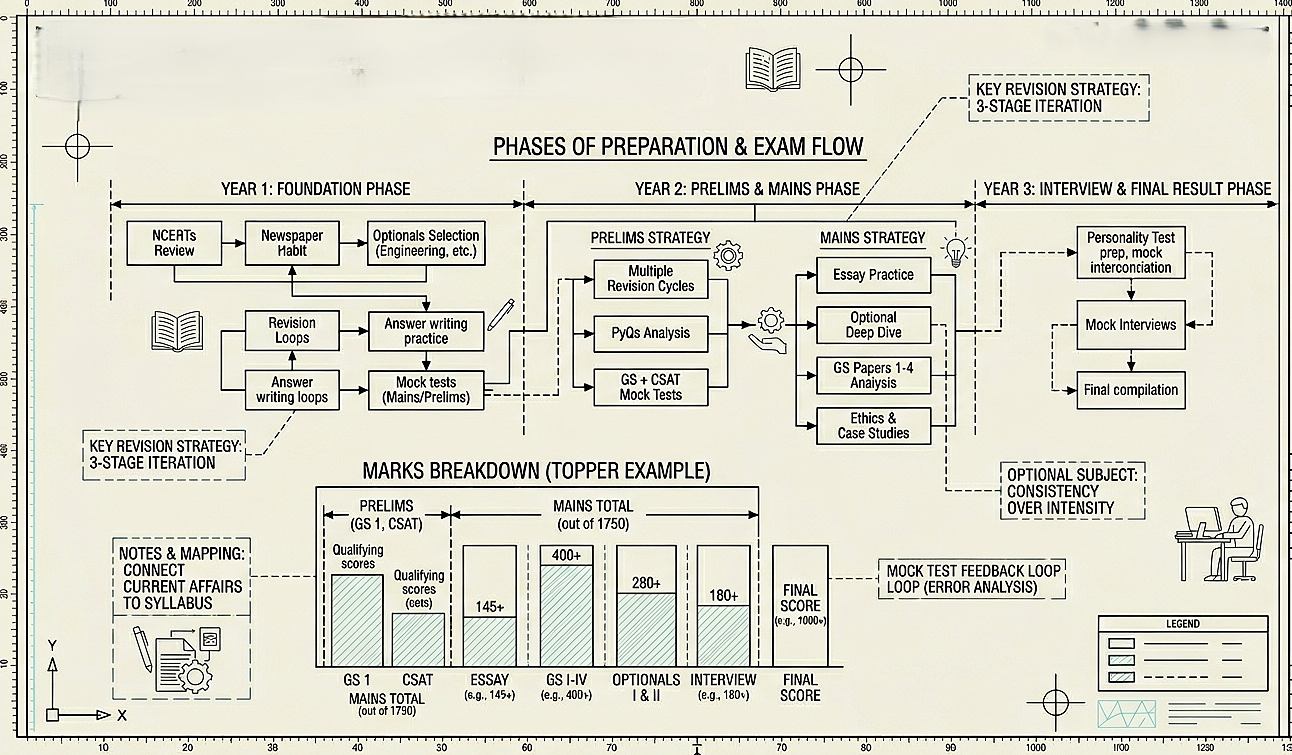
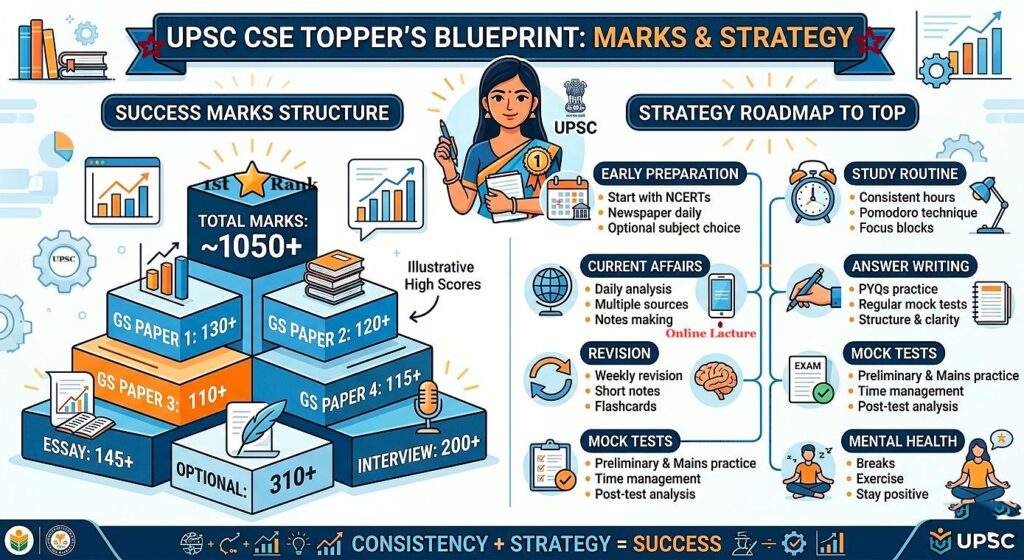
UPSC Exam be become a Top Officer.
Interview: where 200+/275 scores are won
Worth only 13.6% of the total, the Interview is still where final ranks swing the most — toppers in 2025 regularly scored 190–225 out of 275, a range most Mains scores never approach proportionally.
Before the Board call
- Re-read your own Detailed Application Form (DAF) line by line — hobbies, work experience, home district, optional subject — every line is a possible question.
- Track current affairs daily, especially anything connected to your home state, service preference order, and graduation background.
- Do at least 3–5 mock interviews with different panels to get used to varied questioning styles and to catch nervous tics.
In the room
- Boards score composure, clarity and honesty of opinion as much as factual correctness — saying “I don’t know, but here’s how I’d find out” usually scores better than a confident wrong answer.
- Keep answers structured and concise; rambling reduces perceived clarity of thought even when the content is correct.
- Stay consistent with your DAF and your Essay/GS4 answers — contradicting your own written stance is a common scoring trap.
Common high scorers’ pattern
- Candidates from technical/medical backgrounds (engineering, medicine) who can connect their domain to public administration tend to handle situational questions confidently.
- Calm acknowledgement of weak spots, paired with a constructive plan, reads better than defensiveness.
- Service preference order and reasons for choosing civil services are almost always asked — have a genuine, well-thought-out answer, not a rehearsed one.
Quick answers
Do Prelims marks count toward the final rank?
No. Prelims (GS Paper I + CSAT) is purely a screening stage. Only the seven merit-counting Mains papers (Essay, GS I–IV, Optional I & II = 1,750 marks) plus the Interview (275 marks) decide your final rank out of 2,025.
Is there one “best” optional subject?
No single optional guarantees a top rank — 2025’s top 3 alone spanned Medical Science, Sociology and a candidate without a separately disclosed optional. Choice should weigh scoring consistency, available guidance/material, overlap with GS, and genuine personal interest over chasing a trend.
How many attempts does it typically take to reach the top ranks?
It varies widely — some toppers clear it in their first or second attempt, others (like AIR 1 of 2025) succeed in their third. There is no fixed “ideal” attempt number; consistency of preparation matters more than attempt count.
Where can I verify these numbers myself?
Always cross-check current cut-offs, marksheets and vacancy figures directly on upsc.gov.in under the “Examinations → Results” section, since UPSC is the only authoritative source and figures can be revised after initial declaration.