
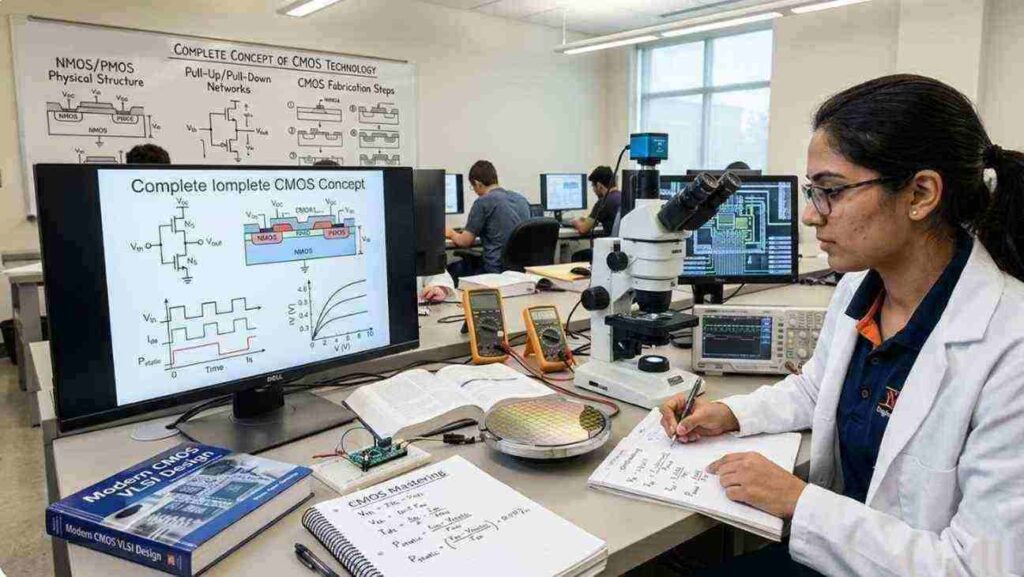
CMOS Technology Complete Guide
Understand the Latest CMOS Technology, circuits, schematics, electrical characteristics, and semiconductor design
CMOS Technology: The Complete Technical Concept
Welcome to this guide based on CMOS technology. Packed with information, this guide covers everything—from fundamental principles to advanced CMOS techniques. Whether you are a student, an engineer, or a researcher, here you will find detailed explanations, applications, and professional-level technical insights..
✓ CMOS circuit schematics with detailed annotations
✓ Electrical characteristics curves and operating regions
✓ Complete manufacturing process flow
✓ Interactive MOSFET parameter simulator
✓ Design optimization and layout principles
✓ Real-world applications and specifications
CMOS Technology Fundamentals
What is CMOS Technology?
CMOS (Complementary Metal-Oxide-Semiconductor) is the dominant semiconductor technology used in modern integrated circuits. It utilizes complementary (Optimized Power) pairs of n-channel (NMOS) and p-channel (PMOS) transistors to create efficient logic gates, analog circuits, and digital systems.
Core Concept of CMOS
Complementary Design
PMOS (pull-up) and NMOS (pull-down) transistors work together. When one is ON, the other is OFF, eliminating static current paths and enabling ultra-low power operation in CMOS circuits.
Full Rail Swing
Output signals swing completely from ground to supply voltage, providing excellent noise margins and superior immunity to noise and process variations in CMOS design.
Scalability
CMOS technology scales efficiently from 28nm down to 5nm and beyond, enabling billions of transistors per square millimeter while maintaining reliability ,durable and performance.
CMOS Device Structure
NMOS transistor cross-section showing the physical structure including gate oxide, source/drain regions, and inversion layer formation
CMOS Circuit Schematics & Logic Gates
CMOS Inverter – The Basic Block Diagram
CMOS inverter: The fundamental building block where PMOS pulls output HIGH and NMOS pulls output LOW
✅ CMOS Inverter Operation
Input LOW (0V):
- PMOS ON → Pull-up network active
- NMOS OFF → Pull-down network inactive
- Vout = HIGH (≈ Vdd, 5V)
Input HIGH (Vdd):
- PMOS OFF → Pull-up network inactive
- NMOS ON → Pull-down network active
- Vout = LOW (≈ 0V)
Key Result: Logic inversion achieved with zero DC static current because only one transistor conducts at a time!
2-Input NAND Gate – CMOS Circuit
CMOS NAND gate: Series PMOS pull-up and series NMOS pull-down networks
| Input A | Input B | Output Y | Configuration |
|---|---|---|---|
| 0 | 0 | 1 | P1, P2 ON |
| 0 | 1 | 1 | P1 ON |
| 1 | 0 | 1 | P2 ON |
| 1 | 1 | 0 | N1, N2 ON |
NAND Gate Features
- Series PMOS → Any transistor OFF pulls output HIGH
- Series NMOS → Both transistors ON pulls output LOW
- Only one current path active at a time
- Zero static power consumption in CMOS design
- Fundamental building block for all logic circuits
CMOS Electrical Characteristics & Performance Curves
I-V Transfer Characteristics
Understanding CMOS electrical characteristics is essential. The graphs below show drain current (Ids) versus drain-source voltage (Vds) for different gate-source voltages, revealing three distinct operating regions with Performance.
CMOS electrical characteristics curves show three distinct operating regions: Saturation (constant current), Linear (resistive), and Cutoff (off)
Operating Regions Analysis
| Region | Condition | Current Equation | Applications |
|---|---|---|---|
| Cutoff | Vgs < Vt | Ids ≈ 0 (leakage only) | Logic OFF, stored state |
| Saturation | Vgs > Vt, Vds ≥ Vgs-Vt | Ids = (μCox/2)·(W/L)·(Vgs-Vt)² | Logic switching, gain |
| Linear | Vgs > Vt, Vds < Vgs-Vt | Ids = μCox·(W/L)·[(Vgs-Vt)·Vds – Vds²/2] | Analog switches, Ron |
| Subthreshold | Vgs << Vt (weak) | Ids = Ids0·exp(Vgs/nVt) | Ultra-low power modes |
Power Consumption Sources
Dynamic Power
Equation: Pdynamic = C·V²·f
Dominates in modern CMOS circuits (~70-80%). Arises from charging and discharging capacitive loads. Reduce by lowering voltage (most effective) or frequency.
⚠️ Short-Circuit Power
Equation: Psc = Isc·V·tpw
Occurs when both transistors momentarily conduct during transitions (~10-20%). Minimize through proper sizing and slew rate control.
🔵Leakage Power
Equation: Pleakage = Ileakage·V
Increasingly critical in sub-28nm nodes. Subthreshold and junction leakage significantly impact standby power consumption.
CMOS Manufacturing Process & Fabrication
Complete 28nm Process Flow
CMOS manufacturing involves hundreds of carefully controlled steps. This overview shows the key process steps for creating integrated circuits at the 28nm technology node.
Complete 28nm CMOS manufacturing process with 10 major steps and technology node progression showing consistent scaling
Advanced CMOS Technologies
FinFET (Fin Field-Effect Transistor)
Node: 22nm and below
- 3D fin structure for better gate control
- Reduced short-channel effects and leakage
- Improved switching characteristics
- Multiple fins for higher drive current
GAA (Gate-All-Around)
Node: 5nm and beyond
- Nanowire channel configuration
- Complete gate wrapping around channel
- Maximum transconductance (gm)
- Ultra-low leakage currents
Interactive MOSFET Test
This interactive CMOS test to calculates MOSFET characteristics in real-time. Adjust the parameters below to understand how gate voltage, drain voltage, and transistor dimensions affect device behavior and determine the operating region.
CMOS MOSFET Parameter Calculator to See Below
Gate-Source Parameters
Drain-Source Parameters
Device Parameters
Operating Region Analysis
(Vgs – Vt)
Peak current
Gain parameter
Linear region
Instantaneous
Input capacitance
CMOS Circuit Design & Optimization
Design Principles & Best Practices
Sizing Strategy
PMOS typically sized 2-4× wider than NMOS due to lower hole mobility. Proper W/L ratios ensure matched rise/fall times and balanced switching characteristics.
Logical Effort
Each gate drives next stage with effort e ≈ 4-6 for minimum delay. Proper path analysis and tapering optimizes critical timing paths.
Layout Matching
Interdigitated and symmetric layouts minimize mismatches. Critical for analog circuits requiring high precision and PSRR/CMRR performance.
Finger Strategy
Divide wide transistors into multiple parallel fingers reducing parasitic RC. Improves switching speed and reduces device mismatch effects.
Power Optimization
Voltage scaling (V²), frequency reduction, and clock gating reduce power. Trade-off between performance and power consumption.
Noise Immunity
Full rail swing and symmetric design maximize noise margins. Proper power distribution reduces IR drops and noise coupling.
CMOS Design Flow Overview
1. Architecture Design: Define functionality and specifications
2. Circuit Design: Create schematics with CMOS logic gates
3. Logic Synthesis: Optimize gate count and timing paths
4. Physical Layout: Implement cells respecting DRC rules
5. Verification: Test functionality, timing, power, and yield
6. Manufacturing: Send to fab following process specifications
1 thought on “Mastering the Complete Concept of CMOS Technology”
Every time I open my account, I feel excited about the new skill and concept of CMOS. The community chat is very welcoming, and I have made some cool friends while chasing that leaderboard implementation. Truly a player first environment and faster .