
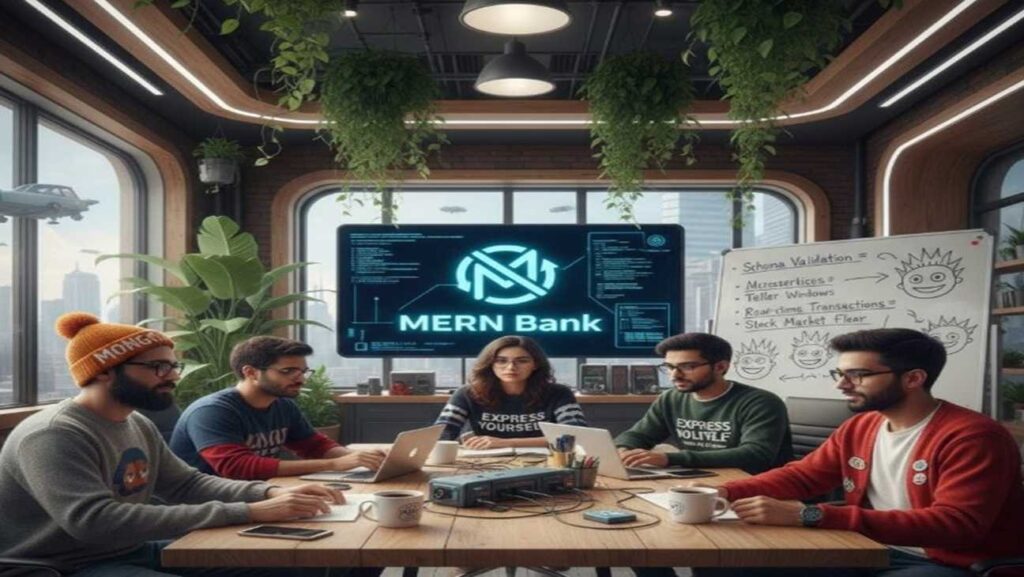
01 The Four Pillars & Banking Financial
MongoDB (Database Tier)
Handling massive ledger volumes with high-availability schemas.
- Multi-doc Transactions: 100% ACID compliance for transfers.
- Field-Level Encryption: Client-side encryption for SSN/Card data.
- Aggregation Framework: Real-time financial reporting & analytics.
- Change Streams: Instant reactive updates to ledger changes.
Express.js (API Layer)
Secured orchestration layer for enterprise financial logic.
- BFF Pattern: Micro-service aggregation for frontend efficiency.
- Zod/Joi Validation: Strict schema validation for incoming money.
- Request Sanitization: Native protection against NoSQL injection.
- Standardized Errors: Global error handlers for API consistency.
React (UX Tier)
Complex state management for real-time asset tracking.
- Redux Toolkit / RTK Query: Managing complex server states.
- Atomic Design: Highly reusable component libraries.
- Code Splitting: Ensuring 1s TTI (Time to Interactive).
- React Hook Form: Handling complex multi-step KYC flows.
Node.js (Core Runtime)
Scalable runtime for non-blocking I/O operations.
- Worker Threads: Offloading heavy interest calculations.
- Buffer & Streams: Handling massive statement exports.
- PM2 Clustering: Maximizing CPU utilization per core.
- Event Loop Monitoring: Identifying lag in transaction processing.
MERN Development Lifecycle (Fintech)
Step-by-step methodology for taking a banking module from concept to a production-hardened environment.
01. Discovery
Regulatory mapping (KYC/AML), stakeholder buy-in, and UX wireframing of financial flows.
02. Schema Design
Designing MongoDB schemas with Mongoose validation, focusing on indexing and atomic transaction boundaries.
03. API Dev
Implementing Controller-Service-Repository patterns in Express with TDD (Test Driven Development).
04. Security Layer
Integrating OAuth2/OIDC, MFA, and rate-limiting middleware to protect sensitive endpoints.
05. Frontend Dash
Building the React SPA/PWA with RTK Query and highly accessible (a11y) UI components.
06. Real-time Synch
Integrating WebSockets via Socket.io for live balance notifications and push alerts.
07. Quality Assurance
Unit testing (Jest), API testing (Supertest), and E2E journeys (Cypress/Playwright).
08. Cloud Scale
Deploying to Kubernetes with Docker, monitoring with NewRelic/Datadog and Sentry.
03 Enterprise Security Hardening
JWT & Refresh Tokens
Implementation of short-lived access tokens and secure, HTTP-only refresh tokens stored in separate databases to prevent session hijacking.
cookie: { httpOnly: true, secure: true }
CSRF & XSS Protection
Using csurf middleware and helmet to set secure HTTP headers (CSP, HSTS) to mitigate common web vulnerabilities.
app.use(helmet());
Request Rate Limiting
Implementing tiered rate limiting (Login: 5/min, API: 100/min) using Redis to protect against Brute Force and DDoS attacks.
windowMs: 15 * 60 * 1000
Advanced Architectural Patterns
Micro-Frontends
Splitting the banking portal into independent React modules (e.g., Credit Cards, Savings) for team autonomy and targeted deployments.
BFF (Backend for Frontend)
A dedicated Node/Express layer that aggregates data from multiple legacy banking microservices into a single optimized payload for the client.
Serverless Integration
Leveraging AWS Lambda or Azure Functions for infrequent, compute-heavy tasks like monthly report generation or risk score calculation.
Event-Driven Architecture
Message Brokering (Kafka/RabbitMQ)
In a distributed banking environment, synchronous calls often lead to cascading failures. We implement asynchronous messaging for:
- Transaction Notification: Triggering SMS/Email alerts post-ledger update.
- Fraud Detection: Piping transaction data to ML models in real-time.
- Account Sync: Updating shadow ledgers in secondary regions.
WebSockets (Live UX)
Using Socket.io for an immersive “Live Bank” experience:
- Live Balances: Updates reflected without page polling.
- Support Chat: Low-latency authenticated customer service channels.
- Stock/FX Tickers: Real-time price streaming for investment modules.
Crucial Fintech Logic
Idempotency Management
Implementation of X-Idempotency-Key headers to prevent accidental duplicate transaction execution on network retries.
Immutable Audit Trails
Using an event-sourced architecture where transaction state is rebuilt from a ledger of immutable events, ensuring 100% auditability.
Role-Based Access Control (RBAC)
Strict enforcement of least-privilege principles, separating administrative actions from standard customer account functions.
Financial Precision (BigInt)
Avoiding floating-point errors by storing money in the smallest currency unit (cents/paisa) as BigInt or using Decimal.js.
Challenges & Enterprise Solutions
Expertise-driven strategies for common banking engineering bottlenecks.
| Banking Challenge | MERN Strategy & Solution |
|---|---|
|
Atomic Consistency
Managing complex multi-account transfers
|
Deployment of MongoDB Native Sessions with
startTransaction() and manual rollback logic for failure states. |
|
Legacy API Latency
Integrating with slow mainframe systems
|
Implementation of Redis Distributed Caching and asynchronous message queuing via RabbitMQ/Kafka for deferred processing.
|
|
Regulatory Data Logging
Keeping logs for 7+ years without tampering
|
Winston logs piped to ELK Stack (Elasticsearch, Logstash, Kibana) with Object Lock in AWS S3 for immutability.
|
|
Sudden Traffic Spikes
Payday loads or promotional surges
|
Kubernetes Horizontal Pod Autoscaling (HPA) combined with Node.js cluster-mode for maximum throughput.
|
|
Compliance Auditing
Passing security audits (SOC2/PCI)
|
Automation of Snyk/Audit CI/CD checks, regular Pen-testing with OWASP ZAP, and strict mTLS service-to-service auth.
|
Fintech Infrastructure (The SRE Layer)
CI/CD Pipeline
- ▶ Static Analysis: SonarQube gates for code quality and security hotspots.
- ▶ Container Scanning: Trivy scans for vulnerabilities in Docker images before pushing to ECR.
- ▶ Canary Deployments: ArgoCD for traffic shifting to ensure new releases don’t break transactions.
Observability Stack
- ▶ Distributed Tracing: Jaeger/OpenTelemetry to track a payment request across 10+ microservices.
- ▶ Log Aggregation: Centralized indexing of PII-masked logs for rapid debugging.
- ▶ Alerting: Prometheus/Grafana with PagerDuty integration for uptime monitoring.
07 Compliance & Financial Standards
ISO 20022 Adoption
Standardizing financial messaging between the MERN backend and external networks (SWIFT/SEPA) using strict JSON-to-XML mapping patterns.
GDPR & Data Sovereignty
Implementing “Right to be Forgotten” logic in MongoDB and ensuring PII never leaves authorized geographical cloud regions via VPC peering.
Frequently Asked Questions
Expert insights on MERN implementation in financial sectors.
Is NoSQL safe for banking?
Yes. MongoDB’s distributed architecture with ACID transaction support (since v4.0) provides the same safety as SQL with much higher scalability for dynamic data.
How do we handle decimal precision?
Developers must avoid JavaScript’s Number type. Use BigInt for integer-based currency (cents) or the decimal.js library for exact decimal representation.
Is MERN scalable for millions?
Absolutely. By utilizing MongoDB sharding and Node.js clustering/worker threads, the stack handles high concurrency with sub-100ms latency.
How do you prevent SQL Injection?
Mongoose ODM handles parameterization natively. Further, strict input validation using Zod or Joi ensures only valid data reaches the DB.
What is the BFF pattern?
Backend-for-Frontend is a Node.js layer that handles aggregation of microservices, keeping the React frontend thin and high-performing.
How to handle real-time updates?
Using WebSockets (Socket.io) or Server-Sent Events (SSE). This allows balance updates to ‘push’ to the user without a refresh.
Why React over Angular?
React’s component model and the huge ecosystem of state management (Redux/Zustand) allow for faster iteration in the competitive fintech market.
Can MERN handle PCI-DSS?
Yes, by ensuring sensitive data (card numbers) is tokenized (using providers like Stripe/Braintree) and never enters the application server scope.
How to handle user sessions?
Implement HTTP-only, Secure, SameSite cookies with JWT (JSON Web Tokens) to prevent XSS and CSRF attacks on financial dashboards.
What is mTLS?
Mutual TLS ensures that both the client and server verify each other’s certificates, which is mandatory for internal banking service-to-service communication.
Statement Generation?
Use Node.js Streams to generate PDFs on the fly. This prevents memory spikes when generating large annual reports for thousands of users.
Is it SEO friendly?
While banking portals are private, for marketing pages, we use Next.js (built on the MERN stack) for Server-Side Rendering (SSR).
Managing Secrets?
Avoid .env files in production. Use enterprise secret managers like HashiCorp Vault or AWS Secrets Manager for database credentials.
What is a Circuit Breaker?
A resilience pattern that stops requests to an external API (like a credit check) if it’s failing, preventing your system from hanging.
Offline Access?
Service Workers allow React PWAs to cache static assets and small data sets for viewing bank balances while offline.
Brute-force protection?
Use express-rate-limit for API endpoints and implementing account lockouts after multiple failed login attempts.
Legacy Integration?
Connect to mainframe systems via message queues (Kafka) or by creating Node.js bridge services that consume SOAP/XML legacy APIs.
Global State?
Redux Toolkit remains the industry standard for managing the complex state required in multi-product financial dashboards.
Best Testing Suite?
A blend of Jest for unit logic, Supertest for endpoint verification, and Cypress for critical user payment flows.
Why TypeScript?
It provides static typing, catching potential calculation or logic bugs during development rather than in production transactions.