
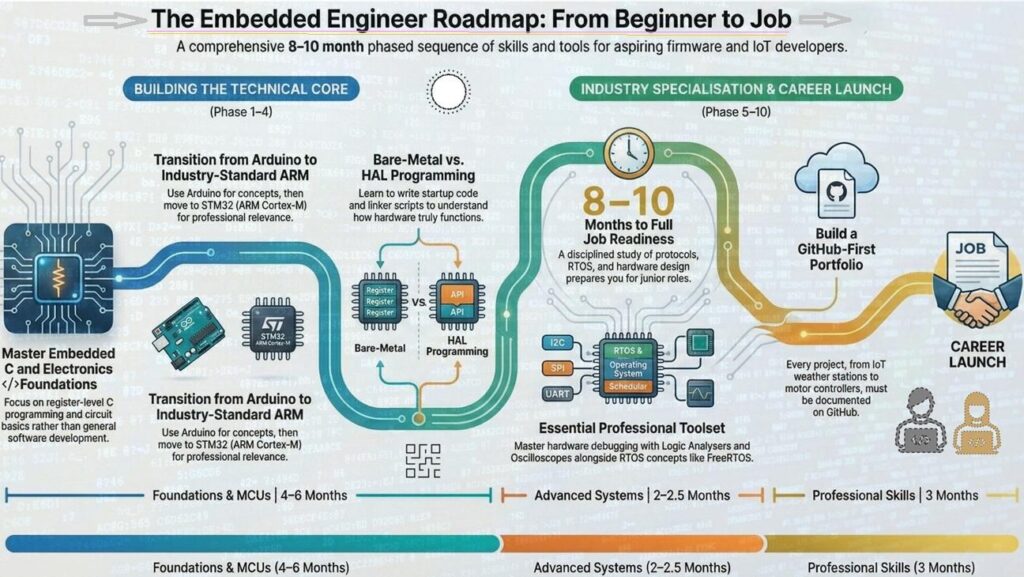
???? Course duration for embedded skills to improve the system roadmap.
Transforming Beginner to Job-Ready Embedded Engineer in 8–10 Months
The Job-Ready Skill Profile
Hardware
Schematic reading, PCB layout (KiCad), Multimeter/Scope usage.
Firmware
Register-level C, HAL/LL libraries, RTOS (FreeRTOS).
Architectures
8051 (Basics), ARM Cortex-M (Advanced), ESP32 (IoT).
Tooling
Git, VS Code/STM32CubeIDE, Logic Analyzers.
Standards
MISRA C, Unit Testing (Unity/CMock), Agile/Scrum.
Logic & Debug
Root-cause analysis, Timing diagrams, Memory Leak detection.
Phase-by-Phase Breakdown
???? Phase 1: Electronics & C Foundations
- Digital Logic: Boolean algebra, MUX/DEMUX, Flip-Flops, Counters.
- Analog: RC filters (crucial for ADC), Op-Amps as comparators, LDO vs. Buck converters.
- Embedded C Focus:
- Bit Manipulation (Set, Clear, Toggle registers)
- Pointers (Arithmetic, void*, function pointers)
- Keywords: static, extern, volatile, const
- Memory Layout: Stack, Heap, Data, and Text segments
- Preprocessing: Macros, #ifdef guards, bit-masking
Deep Tech: Memory Segments
Understand exactly where a variable goes. Global initialized → .data; Global uninitialized → .bss; Local variables → Stack; malloc → Heap.
???? Phase 2: Microcontroller Fundamentals
- Arduino (The Sandbox): Learn logic without register complexity.
- Core Concepts:
- GPIO (Pull-up/down, Push-pull vs Open-drain)
- Interrupts (Edge/Level, Debouncing, NVIC)
- Timers/Counters (PWM, Input Capture)
- Communication: UART (Async), I2C (Two-wire), SPI (High-speed)
⚙️ Phase 3: The “Black Magic” – Bare Metal & ARM
- Transition to STM32CubeIDE for professional development.
- Datasheet Mastery: Finding register addresses in 1000+ page PDFs.
- Clock Trees: PLL, HCLK, and PCLK configurations.
- Linker Scripts: Boot sequence from Power-on to main().
- DMA: Direct Memory Access for CPU-less data movement.
????Phase 4: Advanced Systems & RTOS
- FreeRTOS Concepts:
- Task Management (Priorities, Preemption)
- Synchronization (Semaphores, Mutexes, Priority Inversion)
- Inter-task: Message Queues & Event Groups
- Watchdog Timers: System “Heartbeat” implementation
Advanced RTOS Tip:
Always check your stack size. A stack overflow in a task is the most common cause of a HardFault handler being triggered.
???? Phase 5: Industry Protocols & IoT
Industrial
- CAN Bus: Automotive standard IDs, Frame types (Data, Remote, Error).
- RS-485 / Modbus: Long-distance Master-Slave, Differential signaling logic.
IoT Stack
- ESP32: WiFi/BT with ESP-IDF, Dual-core task pin.
- MQTT: Broker-Client architecture, QoS levels.
- OTA: Secure remote updates & Rollback logic.
Additional Technical Essentials
Memory Management
- Alignment: Understanding why 32-bit variables need 4-byte boundaries.
- Endianness: Big-endian vs Little-endian in network protocols.
- Flash vs RAM: Understanding code execution from Flash vs data storage in SRAM.
- Circular Buffers: Implementing Producers/Consumers for UART data streams.
Power Management
- Sleep Modes: Deep sleep, Light sleep, and Hibernation for battery life.
- Current Consumption: Calculating power budgets for battery-operated devices.
- Brown-out Reset: Protecting the MCU during low voltage dips.
- Wake-up Sources: Using RTC alarms or External GPIO pins to wake the MCU.
Hardware Design & PCB Concept
Professional PCB Layout
- Ground Planes: Why a solid ground plane is mandatory for EMI/EMC.
- Decoupling Caps: Placing 0.1uF caps as close to VCC pins as possible.
- Trace Routing: Avoiding 90-degree angles; using 45-degree bends.
- Differential Pairs: Routing USB or Ethernet signals with matched impedance.
Hardware Debugging Examples
Issue: My MCU resets whenever the motor starts.
Solution: Check for back-EMF. Add a flyback diode and opto-isolators to separate signal and power grounds.
The Portfolio Project Checklist
| Project | Key Skill Taught |
|---|---|
| Smart Weather Station | I2C (Sensors), ESP32 (WiFi), MQTT/HTTP protocols. |
| Bare-Metal Driver | Writing a library for a sensor (e.g., MPU6050) using only registers. |
| CAN Bus Analyzer | Using two STM32s to exchange data via CAN transceiver. |
| USB HID Device | Learning USB stack on STM32 (e.g., custom volume knob). |
| RTOS Data Logger | Managing SD Card (SPI) and Sensors in separate threads. |
| Custom PCB Design | Designing a board for any of the above on KiCad/EasyEDA. |
Debugging Tools
- ST-Link/J-Link: SWD/JTAG Debugging.
- Oscilloscope: Signal integrity & rise times.
- Logic Analyzer: Packet decoding.
- Git/GDB/Unit Testing: Software reliability.
Interview Prep
- Transistor as a switch / Voltage dividers.
- Whiteboard Bitwise Macros.
- Harvard vs Von Neumann Architecture.
- Priority Inversion & Mutex solutions.
Professional Workflow
Version Control
Learn Git Branching models (GitFlow). Never commit binary build files.
CI/CD for Embedded
Automate your builds and run Static Analysis (Linting) on every push.
Defensive Coding
Use assert() and check every function return for errors.