
Telecom voice technologies to world.
VoLTE vs. CSFB vs. SRVCC
This guide provides a comparative technical overview of voice handling mechanisms in LTE networks.
1. VoLTE (Voice over LTE)
Concept
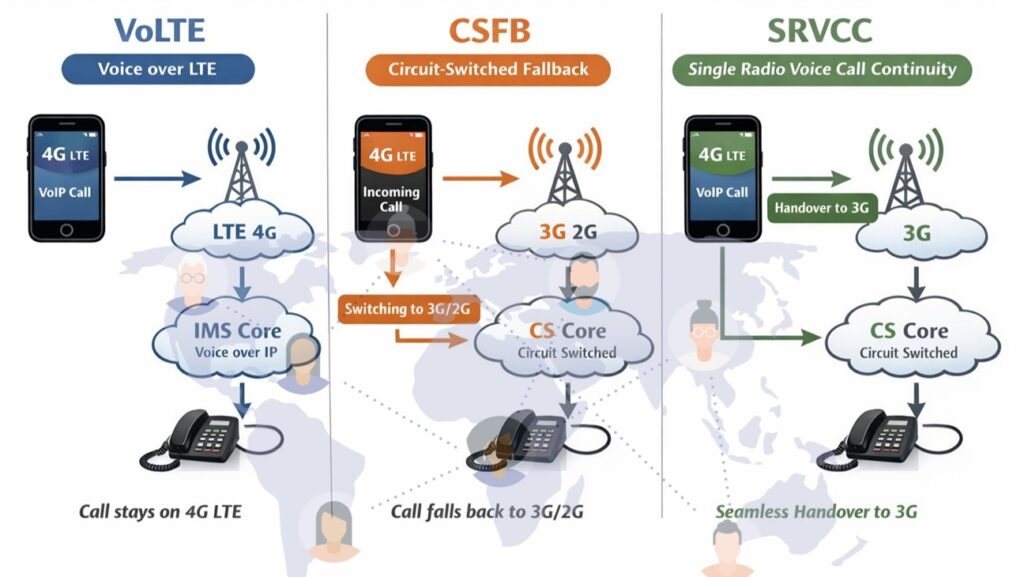
VoLTE is the practice of carrying voice calls over the 4G LTE network using IP (Internet Protocol) via the IMS (IP Multimedia Subsystem) architecture. Unlike legacy networks, voice is treated as data packets rather than using circuit-switching.
How it Works (Call Flow)
The mobile device is registered to both LTE and IMS. Call setup utilizes SIP signaling, and voice packets flow over a dedicated LTE bearer. The entire call remains on the 4G network.
Simplified Flow:
UE → eNB → LTE Core (EPC) → IMS → PSTN / UE
Key Components
- IMS Core: Includes CSCF (Call Session Control Function) and HSS (Home Subscriber Server).
- SIP Signaling: Protocol used for call setup.
- Dedicated Bearer: Specifically QCI=1 (Quality of Service Class Identifier) is reserved for voice traffic.
Pros & Cons
| Advantages ✅ | Disadvantages ❌ |
|---|---|
| Fast Call Setup: Connects in approx. 2 seconds. | IMS Required: The operator must deploy a full IMS core. |
| HD Voice: Superior audio quality (AMR-WB codec). | Coverage Dependent: Requires solid, continuous LTE coverage. |
| Simultaneous Data: Browse 4G internet while talking. | |
| Efficiency: No need to switch radio technologies. |
Use Case
- Jio (India): A pure VoLTE network.
- Modern LTE-only networks.
2. CSFB (Circuit Switched Fallback)
Concept
CSFB allows an LTE device to “fall back” to legacy 3G or 2G networks to handle voice calls. In this scenario, LTE is used strictly for data; when a call occurs, the radio switches technologies.
How it Works (Call Flow)
The User Equipment (UE) camps on LTE for data. When a call is initiated or received, the network signals the UE to disconnect from LTE and switch to the legacy network.
Simplified Flow:
UE (on LTE) → Network Trigger → Fallback → 3G/2G RAN → CS Core
Key Components
- Dual Radio Support: LTE + 2G/3G capability.
- MSC (Mobile Switching Center): Handles the actual call in the legacy core.
- SGs Interface: The interface connecting the LTE MME (Mobility Management Entity) to the MSC.
Pros & Cons
| Advantages ✅ | Disadvantages ❌ |
|---|---|
| Simple Deployment: No need to build an IMS core immediately. | Slow Setup: Switching radios takes time (latency). |
| Legacy Support: Works with older infrastructure. | Data Interruption: 4G data usually disconnects or drops to 2G/3G speeds during the call. |
| Coverage: Leverages established 2G/3G coverage. | Battery Drain: Switching Radio Access Technologies (RAT) consumes power. |
Use Case
- Early LTE deployments (e.g., Airtel, Vodafone during initial 4G launch phases).
3. SRVCC (Single Radio Voice Call Continuity)
Concept
SRVCC is a handover technology designed to maintain an active VoLTE call when moving out of LTE coverage. It seamlessly transfers the ongoing call from 4G (Packet Switched) to 3G/2G (Circuit Switched).
How it Works (Call Flow)
The call begins as VoLTE. As the user moves to the edge of the 4G cell, the signal degrades. The network triggers SRVCC to shift the call to the legacy CS network without dropping the connection.
Simplified Flow:
VoLTE Call (Active) → LTE Signal Weak → SRVCC Handover → 3G CS → Call Continues
Key Components
- IMS: Required for the initial call.
- MSC-S (Server): Enhanced to handle the handover.
- ATCF / ATGW: Access Transfer Control Function/Gateway (anchors the media path).
Pros & Cons
| Advantages ✅ | Disadvantages ❌ |
|---|---|
| No Call Drops: Continuity is maintained during movement. | Complexity: Requires highly complex network architecture. |
| Seamless Experience: User does not notice the switch. | Signaling Overhead: High signaling load between core elements. |
| Mobility: Essential for patchy 4G coverage areas. | Integration: Needs tight coupling between LTE and 3G cores. |
Use Case
- Operators managing the transition period where LTE and 3G networks coexist.
Summary Comparison
| Feature | VoLTE | CSFB | SRVCC |
|---|---|---|---|
| Primary Function | Voice over 4G IP | Fallback to 2G/3G for Voice | Handover of active call 4G → 3G |
| Call Setup Time | Very Fast (~2s) | Slow (due to fallback) | N/A (Handover tech) |
| Data during Call | Yes (4G High Speed) | No (or reduced to 2G/3G) | Drops to 3G speeds |
| Core Requirement | IMS Core | MSC + SGs Interface | IMS + MSC-S + ATCF |
| Voice Quality | HD Voice | Standard CS Quality | Starts HD, may drop to SD |
4. VoWiFi (Voice over Wi-Fi)
Concept
VoWiFi (also known as Wi-Fi Calling) extends IMS voice services by using a Wi-Fi access point as the radio access network instead of a cell tower. This is critical for indoor coverage where LTE/5G signals may not penetrate.
How it Works
The device connects to the operator’s core network over the public internet via a secure tunnel. The call is handled by the same IMS core as VoLTE, allowing seamless handover between VoLTE and VoWiFi.
Simplified Flow:
UE → Wi-Fi AP → Internet → ePDG → P-GW → IMS Core
Key Components
- ePDG (Evolved Packet Data Gateway): The security gateway that sits at the edge of the operator’s core network. It establishes a secure IPSec tunnel with the phone.
- IPSec (Internet Protocol Security): Encrypts the voice traffic as it travels over the untrusted public Wi-Fi network.
Pros & Cons
| Advantages ✅ | Disadvantages ❌ |
|---|---|
| Indoor Coverage: Solves “dead zone” issues in basements/offices. | Wi-Fi Quality: Dependent on the user’s Wi-Fi stability and bandwidth. |
| No Roaming Fees: Calls can often be made from abroad as if at home (operator dependent). | Handover Jitter: Switching between Wi-Fi and LTE can sometimes cause momentary audio glitches. |
5. 5G Voice Evolution (VoNR & EPS Fallback)
As networks move to 5G, voice handling evolves into two main paths: VoNR (the target solution) and EPS Fallback (the interim solution).
5.1 VoNR (Voice over New Radio)
- Definition: The 5G equivalent of VoLTE. Voice calls are carried purely over the 5G Standalone (SA) network.
- Architecture: Uses the 5G Core (5GC) and IMS.
- Benefit: Offers “Ultra Low Latency” and superior quality without needing 4G. True end-to-end 5G experience.
5.2 EPS Fallback (Evolved Packet System Fallback)
- Definition: Similar to CSFB, but for 5G devices. When a user on 5G makes a call, the network pushes them back to 4G LTE (EPS) to complete the call.
- Why used? Many early 5G networks are data-centric and lack full voice optimization.
- Flow: UE on 5G → Call Initiated → Handover/Redirection → UE camps on 4G LTE → VoLTE Call Established.
| Feature | VoNR (Target) | EPS Fallback (Interim) |
|---|---|---|
| Network Used | Pure 5G NR | 5G for Idle / 4G LTE for Voice |
| Call Setup | Instant (<1.5s) | Slower (Wait for 4G Switch) |
| Data Speed | 5G speeds continue | Drops to 4G speeds during call |
6. Voice Codecs: The Quality Layer
The “HD Voice” experience depends on the audio codec used to compress voice data.
AMR-WB (Adaptive Multi-Rate Wideband)
- Standard HD Voice: The baseline for VoLTE.
- Frequency Range: 50 Hz – 7000 Hz.
- Quality: Significantly clearer than 2G/3G (which used Narrowband AMR, capping at 3400 Hz).
EVS (Enhanced Voice Services)
- “Ultra HD” Voice: The most advanced codec designed for VoLTE and 5G.
- Key Feature: Super-Wideband (SWB) support (up to 14,000 Hz or even 20,000 Hz).
- Resilience: uniquely designed to handle packet loss. If a voice packet drops, EVS is much better at “guessing” the missing sound, preventing robotic/choppy audio.
7. Additional Note: SMS over SGs
Concept
For devices using CSFB or LTE-only devices that do not have IMS registration (no VoLTE), how do they receive SMS?
- They use the SGs Interface.
- SMS is encapsulated in LTE control signaling (NAS messages) between the MME and the MSC.
- Result: You can receive SMS while on 4G without needing to fall back to 2G/3G, unlike voice calls which require the fallback in CSFB scenarios.
8. eSRVCC (enhanced SRVCC)
Concept
eSRVCC improves upon standard SRVCC by reducing the handover interruption time. It uses anchor points in the user’s home network to keep the media path stable during the switch from 4G to legacy 3G/2G.
- ATCF (Access Transfer Control Function): Acts as a SIP proxy to anchor signaling.
- ATGW (Access Transfer Gateway): Anchors the media (voice) stream.
- Benefit: Handover interruption is reduced to < 300ms, making the switch nearly undetectable.
9. CS Fallback for SMS (SMS-FB)
Concept
While “SMS over SGs” allows SMS on 4G, some older LTE networks or specific UE configurations might trigger SMS-FB. In this case, the UE behaves exactly like a CSFB voice call, dropping to 3G/2G just to send or receive a text message, then returning to 4G.
- Downside: High signaling overhead for a tiny amount of data.
- Preference: Networks always prefer SMS over SGs or SMS over IP (IMS) to avoid this.
10. VoLTE Emergency Calls (VoLTE-E)
Concept
Emergency calls (911, 112, 999) require special handling in VoLTE. If a UE is not registered to IMS or is “Out of Service” (but sees an LTE cell), it can still initiate an unauthenticated emergency session.
- E-CSCF: The Emergency-Call Session Control Function in the IMS core dedicated to routing calls to the nearest PSAP (Public Safety Answering Point).
- Priority: Emergency bearers are given the highest ARP (Allocation and Retention Priority) to ensure they aren’t dropped even during heavy network congestion.
11. QoS Parameters: QCI, ARP, and Priority
To ensure VoLTE sounds good, the LTE network uses specific Quality of Service (QoS) parameters.
| Parameter | Standard Value for VoLTE | Description |
|---|---|---|
| QCI (QoS Class Identifier) | 1 | Guaranteed Bit Rate (GBR). Low delay and low packet loss. |
| ARP (Allocation & Retention Priority) | 1 (Highest) | Decides if a bearer can be established or dropped during congestion. |
| Budget Delay | 100ms | The maximum allowed time for a packet to travel across the radio link. |
| QCI for Signaling (SIP) | 5 | Non-GBR. Used for IMS registration and call setup signaling. |