
Understanding Embedded Systems: A Complete Guide for Engineers
Learn the basics of understanding embedded systems, from microcontroller to RTOS. Discover how hardware-software integration powers modern IoT and engineering technology in Modern World.
???? Search Keywords
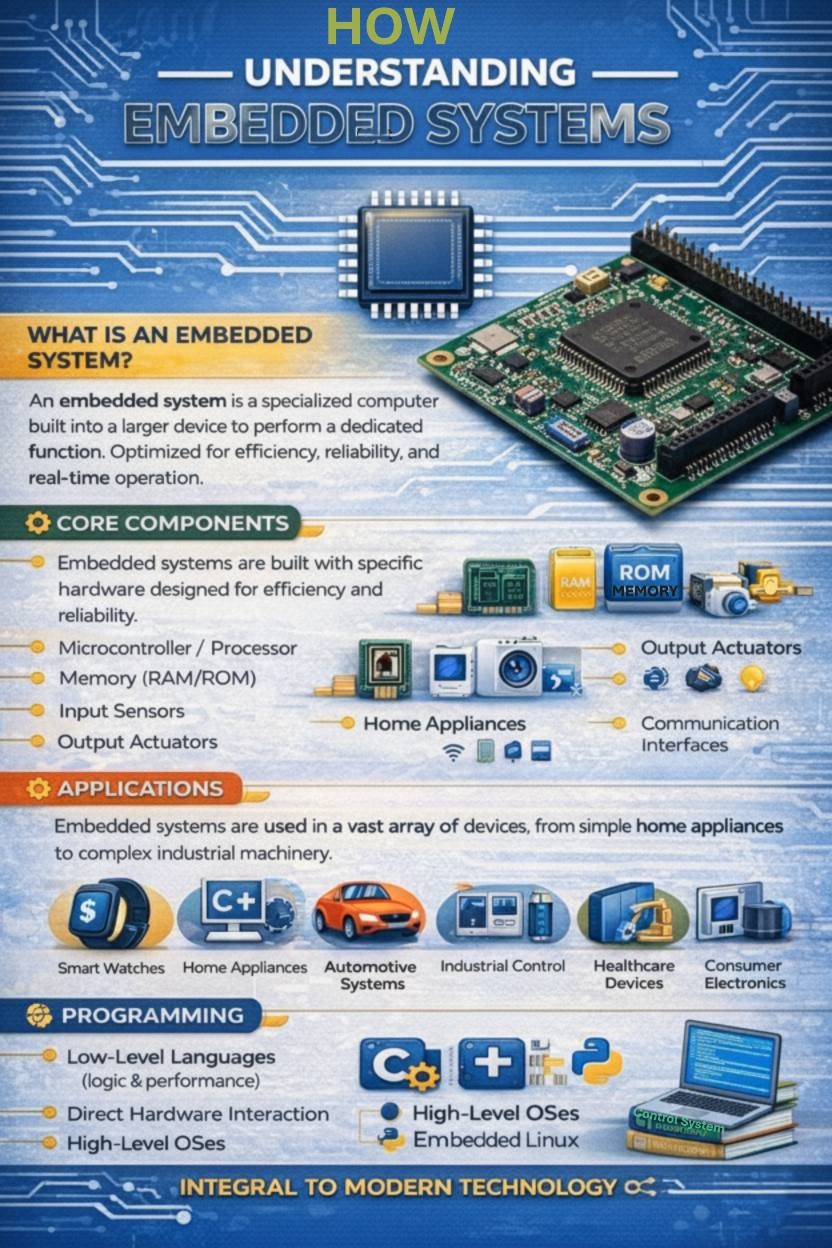
???? What Is an Embedded System?
Most electronics around you run on invisible computers…
From the moment you wake up to the time you sleep, embedded systems are silently working in the background. An embedded system is a special-purpose computer designed to perform one dedicated task inside a larger product.
Unlike laptops or smartphones, embedded systems are not general-purpose—they are optimized to do one job efficiently, reliably, and in real time.
???????? Simple Definition
- A microcontroller or microprocessor (The brain)
- Firmware (Embedded software stored on flash memory)
- Hardware components (Sensors to read data, actuators to take action, and communication interfaces)
All working together to control, monitor, or automate a specific function.
⚠️ Why Embedded is Unique: Microprocessors vs. Microcontrollers
It is critical to understand the distinction between the two foundations of embedded design:
???? Understand and control key concepts in real-time systems.
Microcontrollers & Hardware Design
Unlike a PC’s CPU, a microcontroller (MCU) integrates memory and peripherals on a single chip. Practical experience involves choosing between an 8-bit MCU for a simple TV remote versus a powerful 32-bit ARM chip for a flight controller.
Firmware & Software Development
This is the “soul” of the machine. It’s the low-level code that speaks directly to the hardware. A developer’s life often involves “debugging with an oscilloscope” to see if a signal is actually moving when the code says it should. Often written in C/C++ or Assembly for maximum efficiency.
Real-Time Systems (RTOS)
In many systems, a delay of a few milliseconds isn’t just an inconvenience—it’s a failure. In an automotive airbag system, the “Real-Time” aspect ensures the bag deploys exactly when the sensor detects a collision, not a second later.
IoT Fundamentals
This connects the physical world to the internet. Imagine a smart irrigation system that checks a moisture sensor (Embedded) and pulls weather data from the cloud (IoT) to decide whether to water your crops, saving thousands of gallons of water.
???? How Embedded Systems Talk
Embedded systems aren’t isolated. They use specific communication protocols to talk to other chips and sensors:
???? Real-Life Examples You Use Every Day
Each of these devices contains multiple embedded systems, all working silently in real time.
????️Washing Machine
Notice the “re-balance” pause? That’s an algorithm reading accelerometer data to prevent the drum from damaging itself.
- • Motor speed control
- • Water level & temp sensors
- • Automated wash cycles
???? Car ECU
Modern cars have over 100 ECUs. ABS pulses brakes faster than a human could.
- • Engine timing & fuel injection
- • ABS pulse control
- • Airbag safety triggers
⌚ Smartwatch
Ultra-efficient code allows 24/7 heart monitoring without draining the battery.
- • PPG Motion sensors
- • Bluetooth/LTE sync
- • Battery optimization
???? Why Embedded Systems Are Everywhere
- ✅ Automation: Reduces human effort in factories and homes.
- ✅ Real-Time Operation: Immediate, predictable response to inputs.
- ✅ Efficiency: Low power usage means sensors can run for 10 years on one battery.
- ✅ Reliability: Designed to run for years without reboots or software crashes.
- ✅ Cost-Effective: Small hardware footprint with massive functional impact.
Today, embedded systems power: Home appliances • Medical devices • Industrial machines • Automobiles • IoT & smart devices
???? Why Learning Embedded Systems Matters
Interest Areas:
- Electronics & Hardware Design
- IoT & Smart Cities
- Robotics & Industrial Automation
- Core Engineering Roles (Aero, Medical)
Why it Matters?
Embedded systems power our modern world. Understanding this foundational technology is crucial for anyone involved in electronics, software, or IoT development. It is the bridge between the physical and digital worlds.