
Instrument Landing System (ILS) & Airport Systems Guide
A comprehensive technical reference for Aviation Professionals, Air Traffic Controllers (ATC), and Pilots.
Landing System (ILS) & Airport Systems
The Instrument Landing System (ILS) is the global aviation industry’s standard precision approach system. It provides pilots with both lateral and vertical guidance during the approach and landing phases of flight, particularly in Instrument Meteorological Conditions (IMC). By integrating radio signals with lighting and surveillance systems, the ILS ensures safe, stabilized descents in the most challenging visibility environments.
1. Core ILS Components
A. Localizer (LOC)
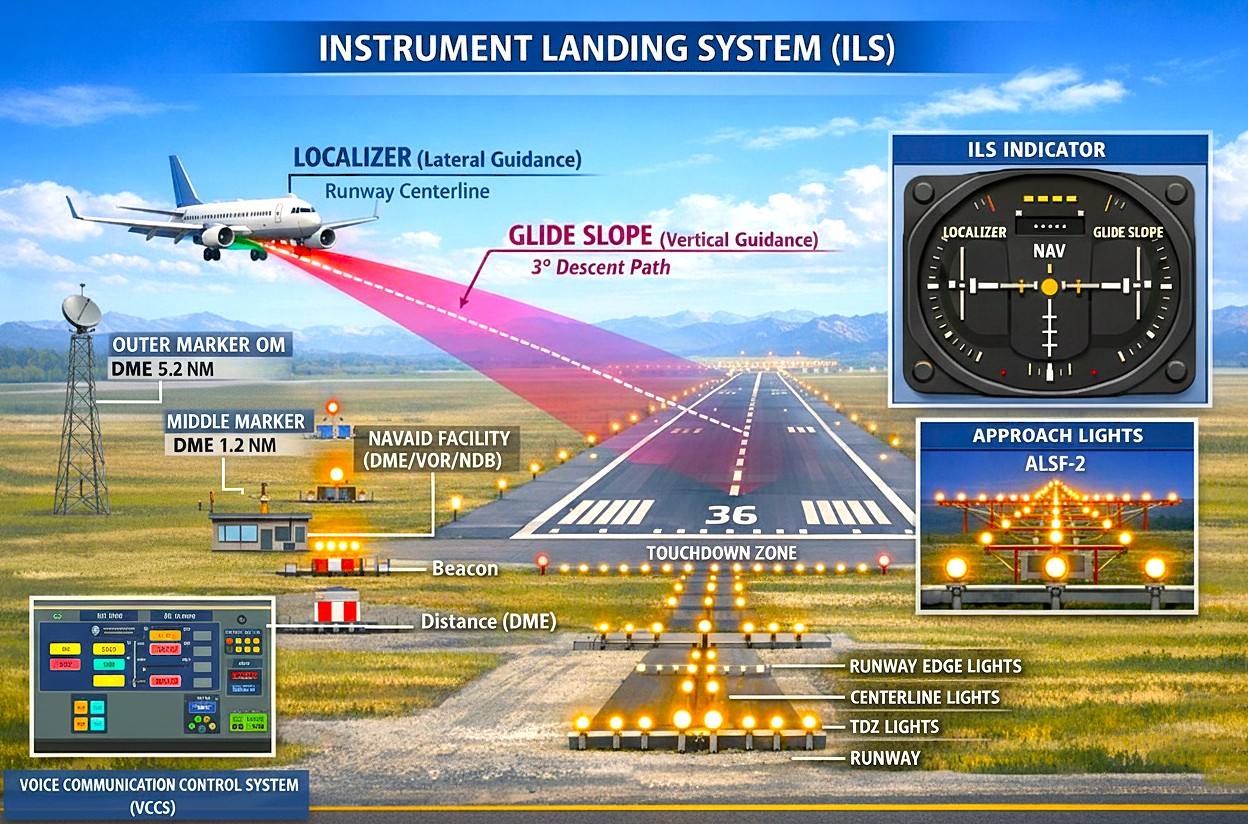
The Localizer provides lateral guidance to align the aircraft with the runway centerline.
- Frequency Range: \(108.10\) MHz to \(111.95\) MHz (VHF). Only odd-tenths (e.g., 108.1, 108.15) are used to distinguish from VOR frequencies.
- Signal Geometry: It transmits two modulated signals: \(90\) Hz (Yellow sector) and \(150\) Hz (Blue sector). The aircraft receiver compares the Difference in Depth of Modulation (DDM). If the \(150\) Hz signal is stronger, the aircraft is right of centerline; if \(90\) Hz is stronger, it is left.
- Coverage: The LOC signal typically provides guidance \(35^\circ\) on either side of the centerline out to \(10\) NM, and tapers to \(10^\circ\) out to \(18\) NM.
- Identification: Transmits a 3-letter Morse code identifier preceded by the letter ‘I’ (e.g., I-LHR).
Figure 1: Localizer Signal Sectors and Centerline Alignment
B. Glide Slope (GS)
The Glide Slope provides vertical guidance for a stabilized descent path.
- Frequency Range: \(329.15\) MHz to \(335.0\) MHz (UHF). These frequencies are “paired” to the Localizer VHF frequency, meaning the pilot only tunes one frequency.
- Descent Path: Normally fixed at a \(3^\circ\) angle, providing a descent rate of approximately \(300\) feet per Nautical Mile.
- Placement: The antenna is located approximately \(750\) to \(1,250\) feet from the approach end (threshold) of the runway, offset \(250\) to \(650\) feet from the centerline.
- Null-Reference: Most modern GS systems use null-reference antennas to create the path via signal interference patterns.
C. Distance Information
Accurate distance information is vital for the pilot to verify their height-to-distance ratio.
- Marker Beacons: High-frequency (75 MHz) directional beacons.
- Outer Marker (OM): \(4\)–\(7\) NM from threshold. (Blue light, low-pitched dashes).
- Middle Marker (MM): \(\approx 3,500\) ft from threshold. (Amber light, alternating dots/dashes).
- Inner Marker (IM): Decision point for CAT II/III. (White light, high-pitched dots).
- DME (Distance Measuring Equipment): Provides continuous slant-range distance. Often co-located with the ILS (ILS/DME), allowing the pilot to see a constant countdown of distance to the “touchdown” point.
D. ILS Protection Areas (Critical & Sensitive)
Because ILS signals are radio waves, they are highly susceptible to reflection and interference from large metal objects.
Critical Area
A specific zone around the antennas. If a vehicle or aircraft enters this area, the signal “needles” in the cockpit may fluctuate wildly. Excluded during all ILS operations.
Sensitive Area
A larger zone where movement is strictly controlled by ATC when the weather drops below CAT I minimums to ensure signal stability for landing aircraft.
3. Communication & Control
A. VCCS (Voice Communication Control System)
The “nerve center” of air traffic control communications. It is an integrated digital switchboard that allows a controller to manage:
- Radio Channels: VHF and UHF ground-to-air communications.
- Landlines: Direct “hotlines” to neighboring ATC centers and emergency services.
- Internal Intercom: Coordination between Tower, Ground, and Delivery positions.
VCCS systems are designed with “Fail-Safe” architecture—if one node fails, another takes over instantly with zero downtime.
B. Remote Tower (R-TWR)
Modern technology allowing ATC to provide service without a physical tower. High-definition 360° cameras and infrared sensors stream a “digital view” to a control center that can be hundreds of miles away. This is highly effective for medium airports or as a contingency for major hubs.
4. How ILS Works: Operations & Roles
The ATC Role (Air Traffic Control)
ATC manages the sequence and ensures separation while guiding aircraft to the “Final Approach Point.”
The Pilot Role
The pilot (or autopilot) captures the radio beams and flies them to the runway.
Operational Example: Landing at Heathrow (LHR)
Approach Stage: Speedbird 123 is descending through 6,000 ft. London Director provides radar vectors for the “base leg.”
Interception: “Speedbird 123, turn right heading 245, cleared ILS runway 27L approach.” The pilot arms the Approach (APP) mode on the Flight Management System.
The Capture: The aircraft turns automatically to align with the LOC. The Glideslope needle begins to move down. As it hits the center, the aircraft pitches to a -3° deck angle.
Landing: At 200 ft (CAT I Minima), the pilot identifies the ALSF-2 lighting system and the TDZL. “Land!” The pilot takes manual control and touches down smoothly.
5. ILS Categories & Minima
Standardized by ICAO, these categories determine how “low” a pilot can go before having to see the runway.
| Category | Decision Height (DH) | Min. Visibility (RVR) | System Requirements |
|---|---|---|---|
| CAT I | \(\ge 200\) ft | \(\ge 550\) m (\(1,800\) ft) | Single ILS receiver, standard lighting. |
| CAT II | \(100\)–\(199\) ft | \(\ge 300\) m (\(1,000\) ft) | Dual ILS receivers, special crew training. |
| CAT IIIA | \(< 100\) ft | \(\ge 175\) m (\(600\) ft) | Fail-Passive Autoland required. |
| CAT IIIB | \(< 50\) ft or No DH | \(50\)–\(175\) m | Fail-Operational Autoland (triple redundancy). |
| CAT IIIC | No DH | No Minima | Total blind landing (Rarely operational). |
6. Visual Infrastructure
The visual components are the “final link” in the chain, allowing the human eye to acquire the runway in low visibility.