
SATELLITE TECH
Systems Engineering Archive
Spacecraft
Systems Design
“To understand a satellite, imagine it as a self-sustaining, high-speed robot living in a vacuum where temperatures swing by hundreds of degrees and radiation is constant.”
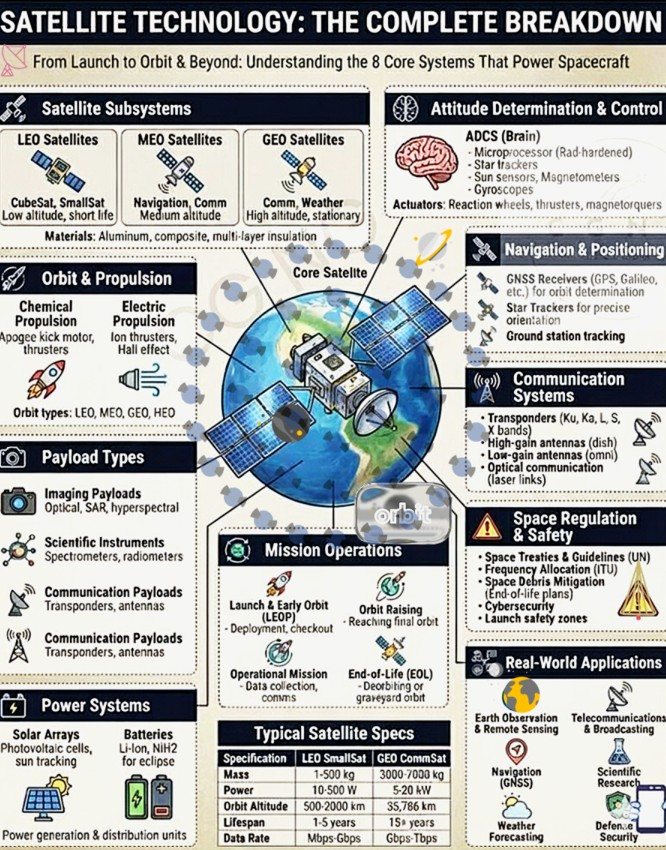
Satellite Overview.
Structure & Materials
Tech Concept
The “bones” that hold everything together and the “armor” that protects the insides from launch and space environments.
Aluminum Alloys (6061/7075)
The “goldilocks” of metals—light enough to launch, strong enough to survive the violent acoustic and vibration loads (up to 20G+) of takeoff.
- • Yield Strength: 276 MPa
- • Density: 2.70 g/cm³
Carbon-Fiber (CFRP)
Near-Zero Coefficient of Thermal Expansion (CTE). Keeps high-precision cameras perfectly in focus regardless of extreme temperature swings.
- • CTE: ~0.1 µm/m·K
- • Modulus: 200+ GPa
Multi-Layer Insulation (MLI)
Made of multiple layers of aluminized Kapton or Mylar separated by fine polyester mesh. It acts like a high-performance vacuum thermos, shielding components from solar radiation and deep-space cold (+120°C to -150°C).
Orbit & Propulsion
Tech Concept
The “legs” that get it to the spot and “feet” that keep it from drifting out of its assigned orbital slot.
Chemical Propulsion
Uses Hydrazine or Bipropellants (MMH/NTO). Instant energy release for rapid orbit raising or emergency avoidance maneuvers.
Electric Propulsion
Accelerates ions (Xenon/Krypton). 10x more efficient than chemical. Low thrust but can run for years, enabling decade-long missions.
Cold Gas Thrusters
Simple compressed nitrogen or helium. Ultra-precise for missions requiring zero contamination and zero vibration for imaging.
Payload Systems
Tech Concept
The “tools” or “senses” that perform the mission’s primary objective, whether it’s taking pictures or relaying calls.
Optical / Hyperspectral
High-res cameras identifying chemical compositions (oil spills, crop health) by breaking light into hundreds of distinct colors.
SAR (Radar)
Synthetic Aperture Radar. Sends pulses that see through clouds, smoke, and total darkness. Vital for 24/7 global monitoring.
Transponders
The relay core: Receives signals (Uplink), frequency-shifts, amplifies by billions of times, and retransmits (Downlink).
Ground Sample Distance (GSD)
The “Zoom Level”: A 30cm GSD means one single pixel on your monitor represents a 30x30cm square on the Earth’s surface. Lower GSD means higher resolution.
Power Systems (EPS)
Tech Concept
The “battery and charger” that provides the constant flow of electrons keeping every digital heart beating.
Triple-Junction GaAs Arrays
30% EFFICIENCYGallium Arsenide cells capturing three different spectrums (Red, Green, Blue/UV) simultaneously. Standard solar tech for spacecraft.
Output
kW / m²
Material
GaAs / Ge
Storage (Batteries)
Li-ion or NiH2. Essential for the “Eclipse”—when the Earth blocks the sun (~15-16 times a day in LEO). Must survive 50,000+ charge cycles.
PCDU (Power Unit)
Power Control & Distribution Unit. The master regulator. Prevents deep discharge and manages high-voltage distribution to payload.
ADCS (Control)
Tech Concept
The “inner ear” and “steering wheel” stopping the satellite from spinning wildly and keeping its eyes on the target.
Sensors (The Input)
High-speed cameras that recognize constellations. Provides absolute orientation with sub-arcsecond accuracy.
Low-power detectors used to locate the sun during initial deployment or in “Safe Mode.”
Actuators (The Output)
Internal flywheels. Changing their spin speed rotates the satellite body without using any fuel (physics of angular momentum).
Electromagnetic coils that “push” against Earth’s magnetic field to dump excess spin energy into the planet.
Thermal Control
Tech Concept
The “skin” that acts as both high-performance air conditioning and extreme-weather insulation.
Dynamic Heat Management
Heat Pipes: Use liquid-gas phase changes to move heat instantly from hot processors to cold radiators. Heaters: Keep electronics in their “survival range” during long eclipses.
Material Radiation
Radiators: Silvered Teflon or white paint that “bleeds” heat into space via infrared. Louvers: Mechanical shutters that open or close based on internal temperature.
Command & Data
Tech Concept
The “Brain” and “Nervous System” that executes every ground command and manages gigabytes of mission data.
Rad-Hardened Computing
Utilizes specialized architectures like RAD750 or LEON3. These chips feature massive redundancy to survive “Single Event Upsets” caused by solar flares.
Nav & Positioning
Tech Concept
The “GPS” that allows the satellite to calculate its own 3D position while moving at speeds faster than a rifle bullet.
Space-Grade GNSS
Modified receivers that handle the Doppler shift of moving at 7.8 km/s. It processes signals from GPS, Galileo, and GLONASS to provide cm-level precision.
Orbit Determination
Mathematical Kalman filters that fuse sensor data with orbital mechanics models to predict the satellite’s exact path weeks into the future.
Communication (RF)
Tech Concept
The “Voice” used to beam petabytes of data down to Earth and receive “Health & Safety” commands from ground control.
L/S-Bands
Omni-directional “Emergency” links. Works in zero-visibility and heavy rain. Low speed, high reliability.
Ku/Ka-Bands
High-bandwidth “Data Pipes.” Used for live TV, satellite internet (Starlink), and high-res imagery transfer.
X-Band
The professional standard for military and scientific Earth observation downlinks. Secure and precise.
Mechanisms
Tech Concept
The “Hinges” and “Motors” that physically unfold the satellite from its compact launch shape into its operational form.
Solar Array Drives (SADA)
Precision stepper motors that rotate the wings (Solar Panels) at the exact rate of the orbit to keep them pointed directly at the sun 24/7.
One-Time Deployables
Spring-loaded hinges, booms, and release nuts. These are Single Point Failures—if they don’t open on day one, the mission is over.
Mission Lifecycle
Tech Concept
The “Ages” of a satellite, from the cleanroom assembly to its final retirement as it burns up in the atmosphere.
Testing
Early Ops
Service
Protocol
Advanced Tech
Tech Concept
The “Next-Gen” innovations turning the orbital environment into a high-speed, intelligent mesh network.
Optical Links (OISL)
Laser communication terminals. Allows satellites to beam data to each other at 100Gbps+ speeds, creating a global orbital internet mesh that doesn’t need ground stations.
On-Orbit AI Computing
Advanced FPGAs and GPUs in space. Allows a satellite to “think”—filtering cloud-covered photos or identifying ships instantly instead of sending raw data to Earth.
Standardized Bus (CubeSats)
Modular 10cm x 10cm x 10cm units (1U). Massive reduction in development time (months instead of years) and launch cost.
Debris Mitigation
Harpoons, nets, and magnetic tugs designed to remove dead satellites, preventing “Kessler Syndrome” and keeping orbits safe for the future.
Orbital Matrix
| System Parameter | LEO (Low) | MEO (Medium) | GEO (Static) |
|---|---|---|---|
| Typical Altitude | 160 – 2,000 km | 2,000 – 35,000 km | 35,786 km |
| Orbital Velocity | ~7.8 km/s | ~3.9 km/s | ~3.07 km/s |
| Signal Latency | ~10 – 30ms | ~100 – 200ms | ~600ms |
| Radiation Load | Shielded | Extreme (Van Allen) | High |
Engineering Trade-offs
SWaP-C Analysis
“Size, Weight, Power, and Cost.”
Spacecraft design is a zero-sum game. If you add 1kg to a camera, you must remove 1kg of fuel or batteries to keep the launch cost within budget.
Redundancy Loops
“Fail-Operational Architecture.”
There is no repair shop in space. Satellites use “Cold” and “Hot” spares—if Primary System A fails, Secondary System B takes over instantly via automated voting logic.
The Vacuum Paradox
“Molecular Bonding.”
Without air, metals can “Cold Weld” together on contact. Mechanisms must use solid lubricants (Moly-Disulfide) or ceramic bearings to prevent seizing.