
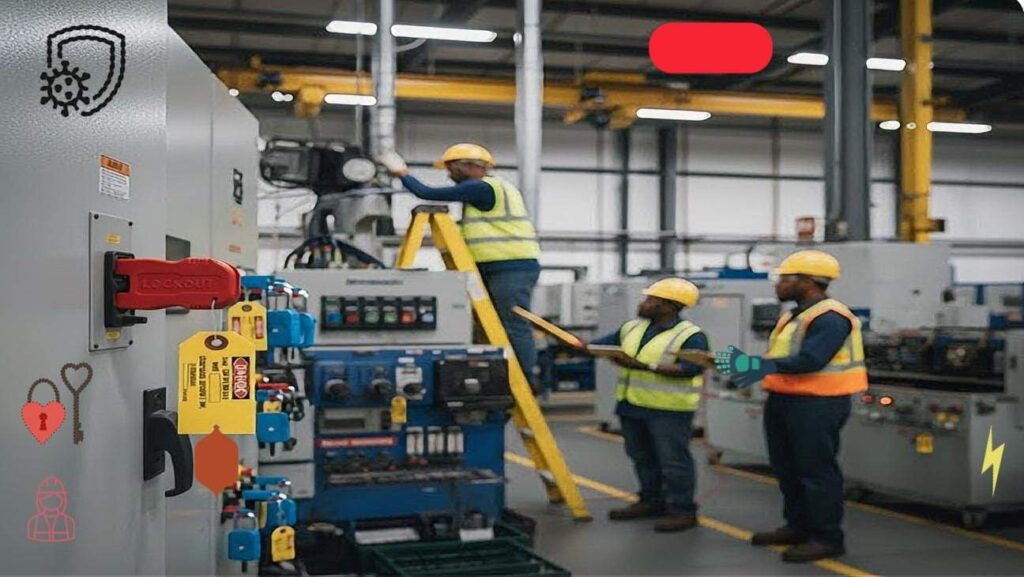
Hazardous Energy Master Control
Prioritize electrical safety: use GFCIs, ensure proper grounding, follow LOTO procedures and industry standards, and de-energize circuits and inspect equipment before use.
Voltage Thresholds & Shock Risks
50 Volts (AC/DC)
Work on exposed conductors above 50V is deemed energized work. This requires a formal permit, detailed LOTO plan, and appropriate PPE.
- Zero Energy Rule: Always verify the absence of voltage before commencing work.
- Below 50V: Generally considered low shock risk under dry conditions.
- Protection: Shock protection boundaries must be established.
25 Volts (AC)
Moisture or highly conductive environments drastically reduce skin resistance, lowering the safe voltage threshold to 25V AC.
- Affected Areas: Confined spaces, pits, outdoor work in rain/high humidity.
- Safety Tools: Handheld equipment and lamps must be low voltage (12V-25V max).
- Risk: Increased risk of sustained muscle contraction (“Let-Go” threshold).
Advanced DC Safety (Stored Energy)
Capacitor Discharge Protocol
Capacitors maintain hazardous potential after shutdown. Always assume they are energized until confirmed otherwise via testing.
- Wait Time: Observe mandatory discharge time (typically 5 times the system time constant).
- Test: Utilize a high-rated DMM (CAT IV) to measure and verify 0V.
- Shorting: Apply dedicated safety shorting probes (with proper AR/shock protection) across terminals.
- DC Danger: Higher resistance often results in “freezing” to the conductor.
Battery Bank & UPS Hazards
High current potential in battery systems (e.g., UPS, Solar Arrays) presents extreme Arc Flash risk despite low voltage levels.
- Primary Risk: Extremely high short-circuit current capability (Arc Flash).
- Chemical/Gas: Ensure dedicated ventilation for hydrogen gas dissipation during charging.
- Mandate: Use fully insulated, high-voltage-rated tools (1000V) to prevent accidental shorting.
- Personal: Remove all jewelry, watches, and conductive personal items.
LOTO (Lockout / Tagout) Procedures
The 7-Point Isolation Sequence
1. Preparation & Identification
Identify all energy sources, system scope, and required LOTO documentation/permit.
4. Device Isolation
De-energize and fully isolate all primary energy sources (racking out breakers, opening disconnects).
5. Lock & Tag Application
Apply the personal lock and tag to the isolation device. Locks are non-transferable and the most critical safety barrier.
6. Release / Block Stored Energy
Discharge capacitors, relieve fluid pressure, block mechanical parts (springs/gravity), and dissipate all residual energy.
7. Verification (The “Try” Step)
Test for voltage (TTV) and attempt to start the machine to confirm Zero Energy State before touching components.
Energized Work Boundaries
Limited Approach Boundary (LAB)
The distance from live parts where an unqualified person must not cross without supervision.
- Access requires formal authorization and escorting.
- Not a shock boundary, but a general safety perimeter.
Restricted Approach Boundary (RAB)
Crossing this boundary significantly increases the risk of shock. Only qualified personnel may cross.
- Requires an active Energized Work Permit.
- Mandatory use of Shock Protection PPE (e.g., insulated gloves).
Arc Flash Boundary (AFB)
The distance where incident energy drops to 1.2 cal/cm² (the threshold for a curable second-degree burn).
- Mandatory Arc-Rated (AR) PPE must be donned outside this line.
- Protects against the primary thermal blast effect.
Arc Flash & Arc Blast Dynamics
Arc Flash: The Thermal Hazard
Extreme heat radiation from the plasma ball, causing instantaneous and severe burns and clothing ignition.
- Temperature: Up to 35,000°F (19,400°C) – vaporizing metals instantly.
- Protection: AR clothing rated for the calculated incident energy protects the skin.
- Burn Injury: Third-degree burns can occur in a fraction of a second.
Arc Blast: The Kinetic Hazard
The resulting shockwave and sound energy, capable of physical destruction, flying debris, and severe internal trauma.
- Pressure: Peak pressures can exceed 2,000 pounds per square foot (PSF).
- Injury: Ruptured eardrums, concussions, collapsed lungs, and fatal body impact.
- Mitigation: Engineering controls like Remote Racking or Arc-Resistant Gear are vital.
PPE and Emergency Response
Required AR PPE
- Insulating Rubber Gloves (Tested & Inspected)
- Arc Flash Suit/Hood (Cal Rated)
- EH Rated Safety Footwear
- Safety Glasses beneath Face Shield
Insulated Tools & TTV
- Tools rated to 1000V (VDE/ASTM certified).
- DMM rated CAT IV for primary circuits.
- Probes with minimal exposed metal tips.
- TTV: Test the meter, test the circuit, test the meter again!
Safe Grounding Practices
After successful TTV, Personal Protective Grounding (PPG) must be applied to prevent accidental re-energization.
- Ground the line, then ground both sides of the work area.
- Ensure connections are clamped securely to bare metal.
Emergency Response
- De-energize Source FIRST. Do not touch victim.
- Immediately call Emergency Services (911/Local).
- Administer CPR/AED if trained and scene is safe.
- Treat for shock and thermal burns.