
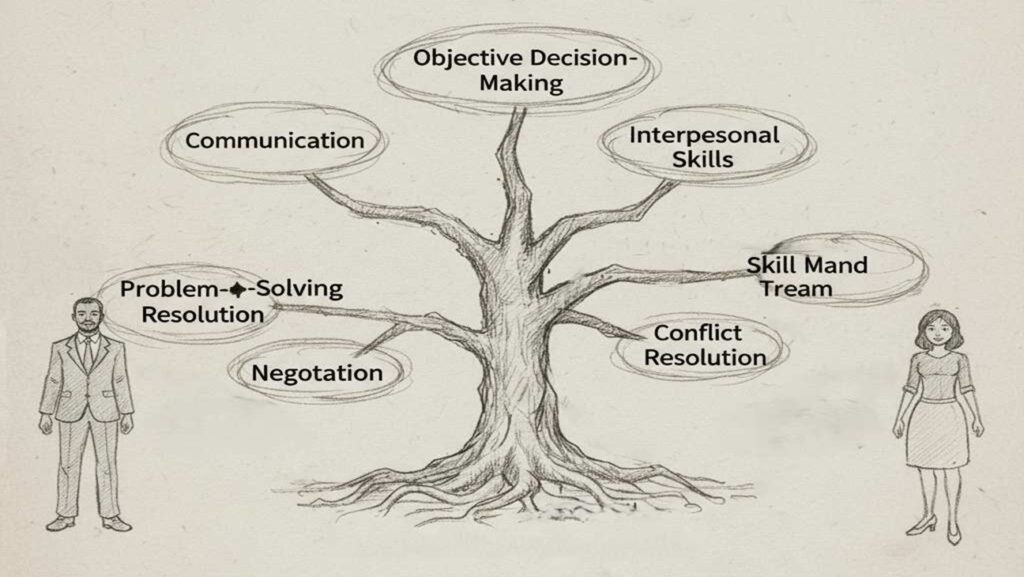
The Intersection of Objective Decision-Making and Interpersonal Skills
Effective professional performance depends on on the “Dual-Skill Model”: the ability to process information logically (Objectivity) & deep informative while directing human dynamics (Interpersonal Skills). When these two are in balance, you achieve “Compassionate Objectivity”—the ability to make hard Productivity choices that people respect and delightful.
1. Defining the Core Pillars of Interpersonal
Objective Decision-Making
The process of making choices based on confirmable facts, logical reasoning, ethical and recognized criteria rather than personal feelings, biases, or social pressure or Political Mind Gams.
- Key Personalities: Critical thinking, risk assessment, fact-checking, and bias mitigation with to consider both parties of points (either user or client or may be same organization)
- The Goal: Maximizing accuracy, Productivity response and fairness.
- Core Skills: Problem-solving, Good Communication skill analytical thinking, prioritization, AI and data interpretation.
Interpersonal Skills (対人スキル / Habilidades Interpersonales)
Interpersonal skills refer to the behaviors and Quick tactics used to interact with others effectively. Understanding what is interpersonal? involves looking at how we communicate and build interpersonal relationships interactions between people or collaboration with others.
- Key Traits: Empathy, active listening, conflict -resolution, foster trust and persuasion.
- Interpersonal Skills Meaning: At its core, it is the ability to work well with others such as – teamwork, leadership, and client or Co-Partner professional settings
- Interpersonal Definition: The word “interpersonal” exactly means “between persons.” i.e. Interpersonal = Inter (Interaction) +(Between) Personal (Individuals Persons). Basically: The space where two individuals’ identities meet.
2. Keyword Reference & Global
To fully outline interpersonal skills, we must look at the various terms used globally and in professional research:
- Terminology & Definitions:
- Interpersonal Meaning: The exchange of information, feelings, and meaning through verbal and non-verbal messages and now in Digital AI Era to exchange visual information, thought and Videos call conformance and Rescheduling auto AI agents
- Interpersonal Communication Skills: Specifically refers to the verbal and non-verbal tools used to transmit messages over Global and Domestic Collaboration and personal or other topics.
- Intrapersonal Skills: = Intra (Within) + Personal (Self-talk) + Skill (Ability) Definition: abilities used to understand and manage oneself, including internal communication, integrity, resilience, and emotional intelligence.
- Personal Skills: A broader category that includes both interpersonal and intrapersonal abilities to understand and delivers information either verbal and non-verbal.
- Examples of Interpersonal Skills:
- Interpersonnel (French): Focuses on social interaction.
- 対人スキル (Japanese): Focuses on social harmony and “reading the room.”
- Interpersonal (India ) = Respect for Hierarchy + Emotional Connection + High-Context of approach “Jugaad”
- Habilidades Interpersonales (Spanish): Focuses on relational success.
- Communication and interpersonal skills: The most common pairing in job descriptions.
3. The Relationship Between the Two
Objectivity and interpersonal skills are interdependent.
| Scenario | Low Objectivity | High Objectivity |
| Low Interpersonal Skills | The Chaotic Actor: Decisions are inconsistent, biasing and alienate the team and more Political aliment. | The Cold Rationalist: Decisions are correct but face resistance or disruption and non -logical. |
| Global Interpersonal Skills | The People Pleaser: Popular decisions that may be strategically catastrophic constructive. | The Wise Leader: Logical decisions implemented with responsiveness and high buy-in with visionary. |
4. Strategies for Balancing Both in skill
A. The “Facts 1st, People 2nd ” Framework
- Use a structured process to separate the logic of a decision from its implications. To develop a more comprehensive and forward-thinking approach to decision-making.
- Analyze (Objective): Use data,” Minutes of meeting” to identify the best course of action.
- Evaluate (Interpersonal): evaluate and identify who will be affected and how they might react and what and how much.
- Perfect (Synthesis): Adjust the delivery or timing of the decision without compromising its core logic and Quality.
B. Practice “Intelligent Struggle” over “Emotional Struggle”
- Intellectual Struggle: Disagreeing over the task or the data. This is healthy and leads to better decisions and right approach.
- Emotional Struggle: Disagreeing based on personality or emotions or when boss blame or incredibility.
- Skill: Use “I (Self)” statements to maintain interpersonal communication.
C. Transparency bridges the gap between objectivity and impartiality
Objectivity can feel like “pressure and stress.” Incorporate interpersonal skills into your leadership style by being transparent about your criteria. When people understand why, what they believe, and what needs to be done, they trust.
Trust = Credibility + Reliability + Intimacy / Self-Orientation}
D. Decisions Require interpersonal skills: the “What’s the “How.”
This is where efficiency and empathy play a crucial role in building personal best practices to build internal interpersonal skills.
Objective decision-making (What): Using facts, data, and logic to choose the best path without emotional bias or blame.
Interpersonal skills (How): Communicating that choice, gaining “buy-in,” and managing team reactions, motivation, and dynamics.
5. Common Drawbacks to Avoid
- Confirmation Bias: Ignoring facts to save face interpersonally.
- The Empathy Trap: Letting interpersonal relationships cloud objective judgment.
- Overconfidence: Assuming your decision-making skill is so perfect it doesn’t require team buy-in.
- Improve Communication and body language: Improve your speaking skills to understand your voice tone and also improve your body and fitness to look good with dress matching.
6. Practical Skills You Need with Examples
6- Objective Decision-Making and Professional Interpersonal Skills
Practical skills are abilities you can apply directly to real-world situations to perform tasks effectively, solve problems, and increase productivity and Thinking power. Adapt to real-world challenges and understand how things work in the real world.
- What are interpersonal skills in practice? active listening, team building, build confidence, Adapt to real-world challenges with AI and negotiation.
- Personal Skills: Time management (intrapersonal) balancing with clear assignment (interpersonal).
- Decision Matrix Training & job performance: It improves productivity by improving task management, prioritization, and problem-solving skills through real-world applications. It emphasizes objective factors while considering social impact, thereby increasing confidence in both personal and professional life.
- The Pre-Mortem: A communication tool that identifies real risks before they happen and alerts you about the latest in-demand skills and trends around the world.
- Final Thought of Intrapersonal Skills:
- Objective decisions provide direction, while interpersonal skills fuel the team’s progress. Without both, leaders risk becoming either “smart loner” or popular but pointless. The ideal “balanced leader” combines objective decision-making (scope) with interpersonal skills, skills that are the “engine” (they Gives Power to move the group ) and the framework for decision-making, forming the soft skills in leadership.